杌
Character Story & Explanation
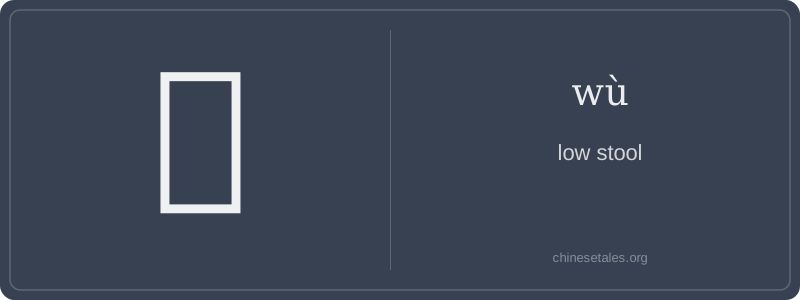
The earliest form of 杌 appears in seal script as a stylized wooden frame: the left side 木 (mù, 'tree/wood') anchors it as a wooden object, while the right side 兀 (wù) — originally a pictograph of a person standing barefoot on a raised platform — gradually lost its human element and became a simplified glyph denoting 'height' and 'stability'. Over centuries, the top stroke of 兀 shortened, the vertical line thickened, and the dot stabilized into its current position — seven clean strokes total: three for 木, four for 兀.
By the Han dynasty, 杌 solidified as a term for a simple, legless, square-cut wooden seat — lower than a bench, higher than a cushion — favored by scholars who valued posture and stillness. In the *Shuō Wén Jiě Zì* (121 CE), Xu Shen defines it as 'a short stool without legs', confirming its functional austerity. Its later poetic extension to 'uneasiness' (in 杌杌) emerges from the image of a stool that wobbles — not from poor craftsmanship, but from the tension of anticipation: think of a minister waiting for imperial decree, seated on a perfectly still 杌, yet inwardly unmoored.
At first glance, 杌 (wù) seems like a humble word — just 'a low stool' — but it’s a quiet time capsule of pre-modern Chinese domestic life. Unlike modern chairs (椅子 yǐzi), which arrived later via Central Asia, 杌 evokes the austere, grounded seating of scholars and elders in Ming and Qing literati homes: unadorned, wooden, waist-high, often placed on tatami-like mats. It carries a subtle sense of quiet dignity — not for lounging, but for contemplation or receiving guests with restrained formality.
Grammatically, 杌 is almost exclusively a noun and rarely appears alone in speech today; it’s mostly found in classical compounds or descriptive writing. You won’t hear ‘I sat on a wù’ in casual Mandarin — instead, it surfaces in phrases like 杌杌 (wù wù), where it redoubles to mean ‘uneasy, restless’ (a semantic shift from ‘unstable stool’ → ‘unsteady state’). Learners sometimes misread it as ‘wū’ (like 乌) due to the ‘兀’ component, but the tone is fourth — sharp and falling, like a stool thumping down firmly.
Culturally, 杌 reminds us how deeply furniture reflects values: its minimalism mirrors Confucian ideals of restraint and function over ornament. Modern speakers rarely use it literally, so encountering it often signals literary allusion or historical flavor — like spotting a Ming dynasty inkstone in a contemporary poem. Mistake it for a common character? You’ll miss the nuance — this isn’t IKEA furniture; it’s a still point in China’s material history.