杓
Character Story & Explanation
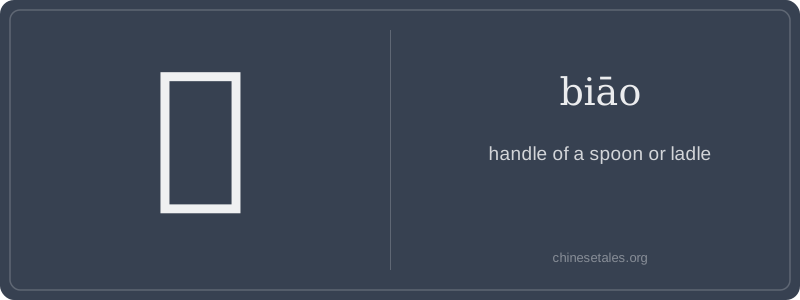
The earliest form of 杓 appears in Warring States bamboo slips as a simple yet elegant pictograph: a vertical line (representing the upright wooden handle) topped by a short horizontal stroke (the junction where the bowl attaches), all anchored by the 木 (wood) radical at the bottom — because ancient ladles were carved from single pieces of hardwood. Over centuries, the top evolved into the ‘丿 + 一’ shape we see today, while the 木 radical stabilized into its familiar six-stroke form — making the total stroke count seven: three strokes above (丿、一、冂-like curve), then four in 木.
This character wasn’t just about kitchenware — in the Records of the Grand Historian, Sima Qian describes imperial astronomers using ‘the dipper’s handle (杓) to point south’ during solstice rituals, linking the earthly tool to cosmic order. The visual logic is tactile: the long, straight 木 radical mirrors the physical length and grain of a carved handle, while the compact upper component suggests the functional ‘head’ — not the bowl itself, but the critical joint where force transfers from hand to vessel. It’s a rare case where a character preserves both craft technique and cosmological metaphor in seven strokes.
Think of 杓 (biāo) as the 'handle' of a spoon — not the bowl, not the whole utensil, but specifically that slender wooden grip you hold while stirring soup. It’s like calling the shaft of a golf club 'the club' in casual speech: technically incomplete, but functionally precise in context. In Chinese, it almost never stands alone; you’ll see it in compound words like 汤杓 (tāng biāo, soup ladle) or as part of classical terms — it’s a specialist’s word, not a conversational one.
Grammatically, 杓 is a noun, and unlike common measure words or verbs, it rarely takes aspect particles (了, 过) or modifiers directly. You won’t say *‘very 杓’* or *‘already 杓’* — it’s too concrete, too artifact-like. Instead, it appears in fixed compounds or descriptive phrases: ‘a bronze 杓 from the Han dynasty’, ‘the 杓 is carved with cloud patterns’. Learners often mistakenly use it where they need 勺 (sháo), the everyday word for ‘spoon’ — but 杓 is narrower, older, and woodier in feel.
Culturally, 杓 carries quiet dignity: it appears in ritual bronzes, Daoist texts describing celestial constellations (the Big Dipper’s handle is 北斗杓), and even in medical classics referring to acupuncture points along the ‘handle-like’ meridians. A common mistake? Pronouncing it sháo — which *is* valid in some contexts (e.g., archaic poetry or dialect), but in standard modern usage for ‘spoon handle’, biāo is correct. Confusing the two sounds can make your sentence sound like historical reenactment instead of lunchtime instructions.