杵
Character Story & Explanation
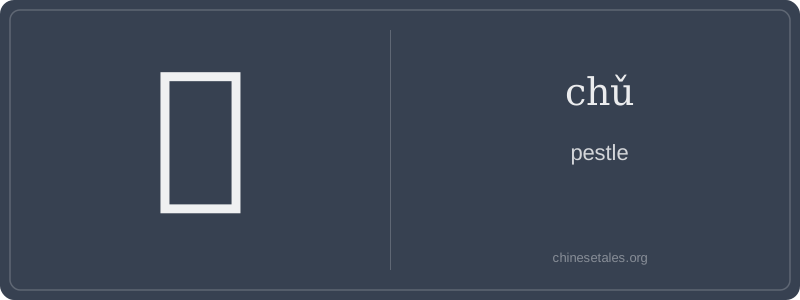
The earliest form of 杵 appears in bronze inscriptions as a clear pictograph: a vertical wooden shaft (the 木 radical at the top) with two horizontal strokes near the bottom representing the thick, weighted end — like a stout club suspended over a mortar. Over time, the top simplified into the standard 木 radical, while the lower part evolved from three strokes (depicting grooves or weight bands) into the modern 古 (gǔ) component — not because it means ‘ancient’, but because its shape conveniently mirrored the balanced, sturdy silhouette of the tool itself. By the seal script era, the eight-stroke structure was locked in: 木 + 古 = a wooden object defined by its enduring, unchanging form.
This visual stability mirrors its semantic constancy: 杵 never strayed far from its core meaning. In the Book of Rites (Lǐjì), it appears in descriptions of ritual grain preparation; in Tang dynasty poetry, it evokes rural labor — ‘the sound of the 杵 at dusk’ symbolizing humble perseverance. Even today, when acupuncturists prepare powdered herbs, they may still refer to the 杵 as the ‘silent partner’ of the 臼 — a pairing so iconic that the phrase 杵臼之交 (chǔ jiù zhī jiāo) metaphorically means ‘a friendship forged through shared hardship’, recalling how these two tools must work in inseparable tandem.
Think of 杵 (chǔ) as China’s ancient kitchen mortar-and-pestle cousin — but with the gravitas of a medieval blacksmith’s tool. It’s not just any pestle: it’s the heavy, blunt, wooden (hence 木 radical) club used to pound grain, herbs, or medicinal ingredients in a stone mortar (臼, jiù). Unlike Western pestles that taper elegantly, 杵 is thick and unyielding — and so is its usage: it almost always appears as a concrete noun, rarely verbified (unlike English ‘to pestle’), and never metaphorically unless in poetic or classical contexts.
Grammatically, 杵 behaves like a simple countable noun: you’ll see it with measure words like 根 (gēn, for long cylindrical objects) — e.g., 一根杵 — or paired rigidly with 臼 in fixed compounds like 杵臼 (chǔ jiù). Learners sometimes mistakenly use it as a verb (*‘I chǔ-ed the garlic’), but modern Mandarin uses verbs like 捣 (dǎo) or 研 (yán) instead. Also, it’s almost never used alone in daily speech — it lives in compound terms or historical/medical texts.
Culturally, 杵 carries quiet authority: in traditional Chinese medicine, precise pounding with a 杵 ensures proper release of herbal essences — too light, and the effect is weak; too hard, and volatile compounds vanish. A common mistake? Confusing it with similar-looking characters like 杜 or 朽 — but those have no connection to pounding. And yes — if your textbook shows 杵 in a folk tale about grinding mooncakes, it’s probably poetic license: real mooncake fillings are kneaded, not pounded!