杼
Character Story & Explanation
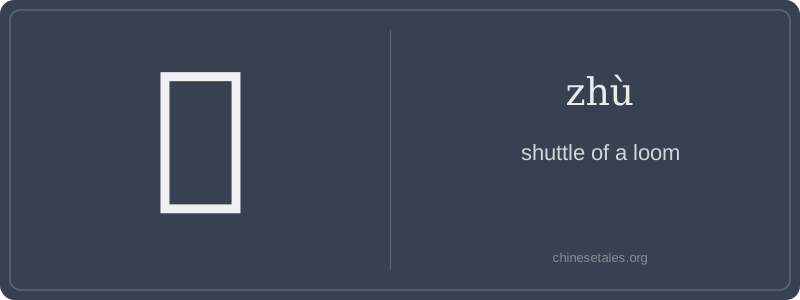
The earliest form of 杼 appears in Warring States bamboo slips and small-seal script, where it clearly combines 木 (wood) on the left with 杙 (yì, an ancient variant meaning ‘post’ or ‘stake’) on the right — not the modern 予. The right side originally depicted a vertical post with a protruding knob, representing the shuttle’s tapered ends and smooth, rounded shape designed to glide. Over centuries, 杙 simplified into 予 (yǔ, ‘to give’), likely due to phonetic borrowing — since both 杙 and 予 were pronounced similarly in Old Chinese (approx. *ləʔ). The eight strokes settled into today’s balanced structure: four for 木, four for 予 — clean, functional, and quietly elegant.
This visual evolution mirrors its semantic journey: from a literal loom part to a metaphor for diligent labor and feminine virtue. In the Classic of Poetry (Shījīng), lines like ‘小东大东,杼柚其空’ lament how war emptied looms — ‘shuttle and axle stand empty’, signaling societal collapse. Later, Sima Qian used 杼 in the Records of the Grand Historian to describe the craftsmanship of legendary artisans. Even today, calligraphers admire 杼’s symmetry: the wood radical grounds it in material reality, while 予 — though homophonous with ‘to give’ — subtly echoes the shuttle’s role: giving motion, giving thread, giving cloth.
At its heart, 杼 (zhù) is a beautifully specific artifact: the shuttle — that slim, boat-shaped tool that carries the weft thread back and forth through the warp on a traditional loom. It’s not just any wooden object; it’s a precision instrument of rhythm and craft, evoking quiet industry, ancestral skill, and the tactile poetry of textile-making. In classical Chinese, 杼 appears almost exclusively in literary or historical contexts — never in daily conversation — so learners won’t hear it in HSK dialogues, but they *will* encounter it in idioms like ‘杼轴’ (zhù zhóu), where it pairs with ‘axle’ to symbolize the entire weaving mechanism — and by extension, the backbone of household production.
Grammatically, 杼 functions as a concrete noun, usually appearing in compound words or fixed expressions. You won’t say ‘I hold a 杼’ in modern speech — instead, you’ll read it in phrases like ‘机杼’ (jī zhù, ‘loom and shuttle’) or in poetic lines praising diligence: ‘寒机夜夜梭,杼声催月落’. Note the tone: zhù is fourth tone — sharp and decisive, like the *click-clack* of a shuttle hitting the loom’s edge. A common mistake? Misreading it as zhū (like 珠) or shù (like 树), both phonetically close but semantically worlds apart.
Culturally, 杼 carries subtle gendered resonance: in ancient China, weaving was central to women’s virtue and economic contribution — hence the idiom ‘织纴组紃,以供衣服’ (weaving, spinning, twisting threads to clothe the family). Confusing 杼 with similar-sounding characters often erases this cultural texture. Also, while 杼 is written with 木 (wood), real shuttles were sometimes made of bone or ivory — but the radical reflects its most common, symbolic material: wood, sturdy and hand-carved.