枊
Character Story & Explanation
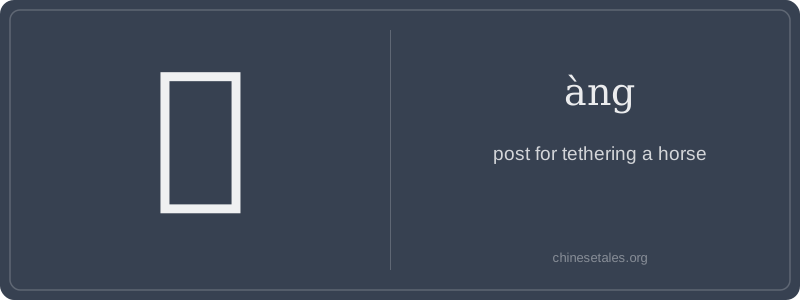
The earliest form of 枊 appears in bronze inscriptions of the late Zhou dynasty (c. 5th century BCE) as a highly pictographic glyph: a vertical line (丨) representing a wooden post driven into the ground, with two short horizontal strokes (一 一) near the top — symbolizing rope loops or carved notches where reins were tied. Over centuries, the top loop evolved into the ‘sun’ component 日 (rì), while the vertical post fused with the ‘tree/wood’ radical 木 (mù) at the bottom, creating the modern structure: 日 above 木. This wasn’t arbitrary — wood was the material, and the sun-shaped top may have indicated a carved emblem or sun-bleached wear on the post’s crown.
By the Han dynasty, 枊 appeared in texts like the *Shuōwén Jiězì* (c. 100 CE) explicitly defined as ‘a post for restraining horses’ (馬杙也 — mǎ yì yě). It appears in Du Fu’s poetry describing abandoned frontier posts, and in Song-dynasty travelogues noting ‘weathered 枊 standing silent beside the ruined relay station.’ Its visual logic held: the 日 isn’t ‘sun’ here — it’s a stylized knot or collar; the 木 isn’t just ‘tree’ — it’s ‘wooden object’. The character didn’t shift meaning; instead, its referent faded from daily use, leaving behind a perfect fossil of equine logistics.
Let’s be honest — 枊 (àng) is a character you’ll almost never see in daily life, and that’s part of its charm. It means ‘a post or stake used to tether horses,’ evoking ancient stables, dusty caravan stops, and the quiet authority of something sturdy and rooted in the earth. In classical Chinese, it functioned as a noun — always concrete, always physical — and never as a verb or adjective. You won’t find it in modern news or social media; it lives in historical texts, poetry, and antiquarian dictionaries. Its feel is archaic, dignified, and slightly lonely — like an old stone post half-buried in a forgotten courtyard.
Grammatically, 枊 behaves like any monosyllabic noun: it appears after measure words (e.g., 一根枊 — yī gēn àng, ‘one post’), modifies other nouns with 的 (e.g., 枊头 — àng tóu, ‘the top of the post’), or serves as the subject/object in literary descriptions. But here’s the catch: learners often misread it as áng (like 昂) or confuse it with 桉 (ān, eucalyptus tree) — both visually and phonetically close. And crucially: 枊 is NOT used metaphorically in modern speech. You wouldn’t say ‘tethering emotions’ with this character — that’s poetic license, not usage.
Culturally, 枊 reflects how deeply infrastructure shaped early Chinese life: every well-run estate, military camp, or post station needed secure horse-tethering. Yet its near-total disappearance from spoken language tells a story too — as horses gave way to carts, then trains, then cars, the physical anchor lost its urgency. Modern readers may stumble over it in Tang poetry or Ming novels, but they’re encountering not just a word, but a vanished piece of material culture — preserved only in ink and stroke.