枙
Character Story & Explanation
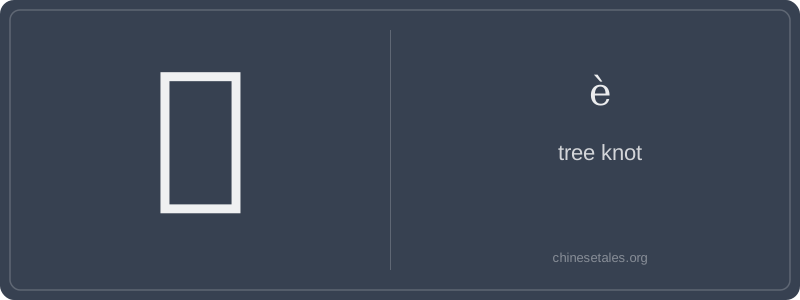
The earliest form of 枙 appears in bronze inscriptions as a highly stylized pictograph: a vertical trunk (木) crossed obliquely by two short, angular strokes — like a tiny 'X' embedded in the wood — representing the cross-section of a branch base fused into the main stem. Over centuries, the 'X' simplified into the top component 亞 (yà), which originally depicted a sacrificial altar but here was borrowed purely for sound (è) and visual density. Meanwhile, the 木 (mù, tree) radical anchored the meaning. By the Han dynasty, the form stabilized into today’s 枙: 亞 atop 木 — a compact, symmetrical glyph that visually *embodies* a knot’s concentric tension.
This evolution reflects how Chinese characters often fuse phonetic borrowing with semantic anchoring. Though 亞 means 'second' or 'subordinate', here it contributes only the è sound — a classic example of phono-semantic compounding. Classical texts rarely use 枙 alone; instead, it appears in compound terms like 枙节 (è jié) in Tang dynasty forestry records, where it describes timber defects affecting structural integrity. The character’s enduring power lies in its precision: it names not just any irregularity, but the *biological origin point* of wood’s inner strength — a silent signature of growth under pressure.
Let’s be honest — 枙 (è) is a quiet, almost secretive character. It doesn’t shout; it whispers through the grain of wood. Its core meaning — 'tree knot' — isn’t about decoration or flaw, but about *resistance*: the dense, twisted place where a branch once joined the trunk, where sap fought its way around an obstacle. In Chinese, 枙 carries a tactile, almost geological weight — you feel its density when you say è, a low, abrupt tone that mimics the solid 'thunk' of tapping a knotty section of timber.
Grammatically, 枙 is almost always a noun and appears in technical, literary, or artisanal contexts — never in daily small talk. You’ll find it in carpentry manuals (e.g., 枙节), forestry reports, or classical poetry describing aged pines. Crucially, it’s *not* used as a verb ('to knot') — that’s 打结 (dǎ jié) or 纠结 (jiūjié). Learners sometimes mistakenly use 枙 where they mean 'knot' in rope or hair; but no — this character belongs only to wood, and specifically to the *anatomical* knot formed by a buried branch base. Think of it as botany’s scar tissue.
Culturally, 枙 evokes resilience and hidden strength: ancient Chinese admired gnarled, knotted pine trunks (松枙, sōng è) as metaphors for enduring virtue amid adversity. A common mistake? Confusing it with 柏 (bǎi, cypress) or 柄 (bǐng, handle) — both share the wood radical but zero semantic overlap. Remember: 枙 is not decorative, not functional — it’s structural memory frozen in wood.