枸
Character Story & Explanation
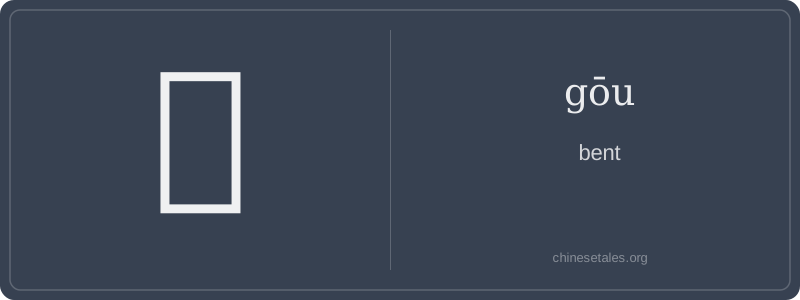
The earliest form of 枸 appears in seal script (around 300 BCE), where it clearly shows 木 (tree/wood) on the left and 句 (jù, ‘curved’, later simplified to 句-like shape) on the right. The 句 component originally depicted a bent arm or a crooked hook — a pictograph of something deliberately arched — and when fused with 木, it created a character meaning ‘wood that bends’. In bronze inscriptions, the right side even had a small curl at the top, mimicking a stem curving back on itself. Over centuries, the 句 part streamlined: the dot became a stroke, the curved line straightened slightly, and the final hook sharpened — yet the sense of gentle arc remained locked in the shape.
This visual logic carried straight into meaning: by the Han dynasty, 枸 appeared in texts like the *Shuō Wén Jiě Zì* (121 CE) defined as ‘a shrub with twisted branches’, specifically naming the goji plant. Classical poets used 枸 metaphorically too — Du Fu once described autumn willows as ‘枸枝垂野’ (gōu zhī chuí yě), ‘bent boughs hanging over the fields’, evoking melancholy grace. Even today, the nine strokes trace a subtle S-curve: the slanting wood radical leans left, while the 句 component curls right — the whole character is, quite literally, a calligraphic bend.
At first glance, 枸 (gōu) feels like a quiet, almost forgotten character — it’s not in the HSK, rarely appears alone in modern speech, and its core meaning ‘bent’ is more poetic than practical. But don’t dismiss it! This character is a semantic fossil: it captures the visual essence of something arched, twisted, or gently curved — think of a willow branch bowing over water, not a sharp kink or a broken angle. The ‘bent’ here implies natural, graceful curvature, often with connotations of resilience or yielding without breaking.
Grammatically, 枸 almost never stands alone as a verb or adjective in contemporary Mandarin. Instead, it lives embedded in compound nouns — especially botanical terms like 枸杞 (gǒuqǐ, goji berry), where it contributes an ancient layer of meaning tied to the plant’s gnarled, winding stems and twisted branches. You’ll never say *‘this stick is gōu’* — but you *will* see 枸 in scientific names, herbal medicine texts, and regional dialects describing vine-like growth patterns. Learners sometimes misread it as ‘hook’ (gōu) due to the homophone, but this character has zero connection to hooks or grappling — it’s about organic bend, not metallic grip.
Culturally, 枸 is a whisper from classical botany: pre-modern Chinese herbalists named plants by observing morphology, and 枸 was chosen precisely because the Lycium shrub grows with contorted, arching twigs. A common mistake? Assuming it’s interchangeable with 弯 (wān, ‘to bend’) — but 弯 is dynamic (a verb), while 枸 is static and descriptive, rooted in plant anatomy. Also, watch your tones: it’s *gōu*, not *gǒu* (dog) — confusing them could turn a medicinal herb into a very confused canine!