柈
Character Story & Explanation
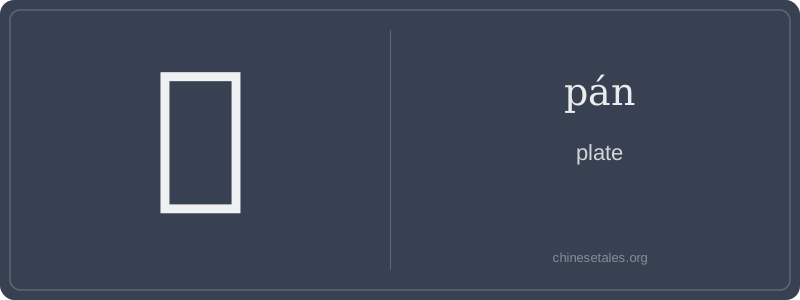
Carved into late Shang oracle bones and Western Zhou bronzes, the earliest form of 柈 looked like a simple wooden basin: two parallel horizontal lines (the rim) resting on a curved base, with a vertical stroke down the center — representing the grain of the wood. Over centuries, the base simplified into the 木 radical at the bottom, while the top evolved from pictographic rim-and-bowl into the modern 上 part — not ‘up’, but a stylized, flattened vessel outline. By the Han dynasty, clerical script had cemented the structure: 木 supporting a hollow, open shape — unmistakably a hand-carved wooden dish.
This wasn’t just dinnerware: in the *Book of Rites* (Lǐjì), 柈 appears in descriptions of ancestral rites — ‘a plain 柈 of paulownia wood, unvarnished, holding millet cakes’. Its wooden nature was essential: unlike bronze sacrificial vessels (dǐng, zhōng), 柈 signified humility and purity. Even in Tang poetry, when Li Bai wrote ‘手捧一柈松子’ (‘holding a bowl of pine nuts’), he chose 柈 over 盘 to evoke rustic sincerity — the very grain of the wood whispering through the character.
Here’s the truth no textbook tells you: 柈 isn’t just ‘plate’ — it’s a *ceremonial vessel* frozen in ink. Its core meaning evokes something shallow, round, and purpose-built for holding: food, offerings, or even symbolic things like fate (as in the idiom ‘命悬一柈’ — ‘life hanging by a single plate’). Unlike the neutral, everyday 盘 (pán), which dominates modern usage (think computer hard drive or food tray), 柈 carries antique weight — it appears almost exclusively in classical texts, poetry, or regional dialects (like Shandong or Henan folk speech), where it conveys rustic authenticity or ritual solemnity.
Grammatically, 柈 behaves like a countable noun and takes measure words like 一柈 (yī bàn) — yes, that’s the same sound as ‘bàn’ but with a different character and tone (bàn, fourth tone). Learners often misread it as pán (first tone) because of its pronunciation in dictionaries — but in real historical usage, it’s nearly always bàn. You’ll never see it in HSK materials because it’s functionally obsolete in standard Mandarin; using it in daily speech would sound like quoting Confucius at a Starbucks.
Culturally, 柈 is a quiet rebel: while 盘 evolved into abstract uses (e.g., 盘点 ‘to inventory’, 盘问 ‘to interrogate’), 柈 stubbornly stayed physical, earthy, and edible — literally rooted in wood (its radical is 木, ‘tree’). Mistake it for 盘 and you won’t be wrong grammatically, but you’ll lose centuries of poetic texture — like replacing ‘chalice’ with ‘cup’ in a medieval ballad.