柏
Character Story & Explanation
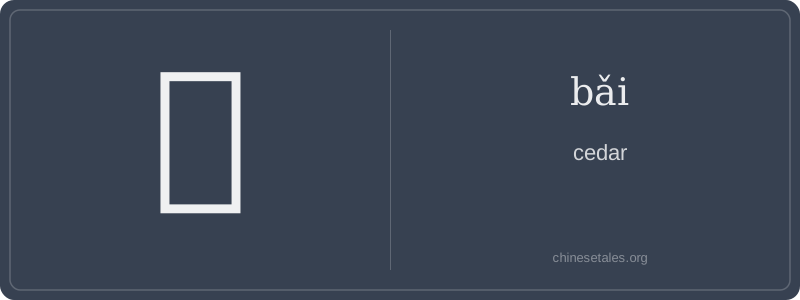
The earliest form of 柏 appears on Warring States bamboo slips — already recognizable as a tree (木) paired with 白. Oracle bone inscriptions don’t contain 柏, but bronze script shows a stylized tree with a simplified ‘white’ element beside it: not a pictograph of bark or needles, but an elegant phonetic marriage. Over centuries, the 木 radical narrowed slightly, the horizontal stroke in 白 became cleaner, and the dot evolved into a precise, centered point — nine strokes total, each placed with calligraphic intention: 一 (top horizontal), 丨 (trunk), 丿 (left branch), 丶 (dot), 丿 (upper right stroke), 丨 (vertical), 一 (base horizontal), 丿 (lower right), 丶 (final dot).
In classical texts like the *Book of Rites*, 柏 appears in descriptions of ritual groves — evergreen trees symbolizing unbroken filial piety and ancestral reverence. Its name evokes both sound and substance: bǎi echoes the rustle of wind through dense, aromatic foliage, while its visual symmetry mirrors the tree’s upright, unwavering growth. Confucius reportedly praised the 柏 for standing firm in winter — a metaphor later embedded in ink paintings and garden design, where a single 柏 tree signifies quiet moral resolve.
At its heart, 柏 (bǎi) is the cedar — not just any tree, but a symbol of enduring strength and quiet dignity in Chinese culture. Its radical 木 (mù, 'tree') anchors it firmly in the botanical world, while the right-hand component 白 (bái, 'white') isn’t about color here — it’s a phonetic clue, hinting at pronunciation (bǎi sounds close to bái). Visually, it’s a masterclass in semantic-phonetic balance: left for meaning, right for sound. Unlike many nature characters, 柏 rarely appears alone in speech; you’ll almost always meet it in compounds like 柏树 or in names.
Grammatically, 柏 behaves like a noun root — no verb forms, no adjectival inflections. It doesn’t ‘do’ anything; it *is*. You won’t say ‘I柏’ or ‘very柏’ — that’s a dead giveaway of beginner interference from English. Instead, it shows up in descriptive noun phrases (e.g., 柏树林 — 'cedar grove') or proper nouns (like surnames or place names). Learners often misread it as bái due to the 白 component — a tiny tone slip that swaps ‘cedar’ for ‘white’!
Culturally, cedars are revered for longevity and resilience — they’re planted near temples and tombs across China and Korea, embodying steadfastness. Interestingly, 柏 is also a common surname (Bǎi), pronounced identically — so context decides whether you’re talking about a tree or your neighbor’s grandfather. And yes, despite its botanical precision, most modern speakers wouldn’t use 柏 alone to mean ‘cedar’ in casual talk; they’d say 柏树 (bǎi shù) — the full compound feels safer, more natural.