柒
Character Story & Explanation
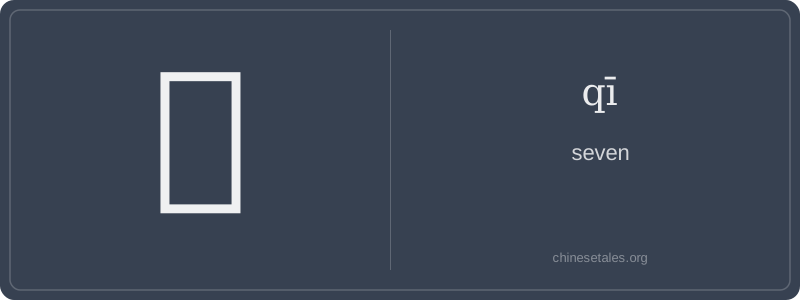
The earliest form of ‘seven’ was the simple oracle bone character 七 — a horizontal line crossed by a vertical stroke, evoking a tally mark or a knife cutting across a count. By the Han dynasty, scribes began creating ‘anti-alteration variants’ for numerals used in money matters. To transform 七 into 柒, they added the 木 (mù, ‘wood’) radical on the left — not because wood relates to numbers, but because wood’s stable, upright structure made the character bulkier and harder to forge. The right side evolved from 口 (kǒu) to 氐 (dǐ), then simplified to the current shape: a compact, angular ‘seven’ fused with a strong left-hand pillar.
This wasn’t calligraphic whimsy — it was forensic linguistics. In Tang-dynasty tax records and Song-era banknotes, 柒 appears alongside other ‘big-numeral’ forms like 壹 (yī), 貳 (èr), and 叁 (sān). Unlike poetic numerals in classical texts (e.g., ‘seven stars’ in the Book of Songs), 柒 never carried symbolic weight — no mystical associations, no Daoist numerology. Its sole mission: to stand firm, unchangeable, and unmistakably seven — a silent guardian of value in ink and paper.
At first glance, 柒 looks like a fancy cousin of 七 (qī, 'seven') — and it is! But here’s the twist: 柒 isn’t used in everyday speech or writing at all. It’s a *financial character*, born from ancient Chinese accounting practices to prevent tampering. While 七 is quick, simple, and ubiquitous, 柒 is deliberately ornate — its nine strokes and wood radical (木) make it hard to alter with a single stroke (e.g., turning 七 into 十 or 八). So when you see 柒, you’re not reading poetry — you’re looking at a 1,300-year-old anti-fraud shield.
Grammatically, 柒 functions identically to 七 — as a numeral — but only appears in formal financial contexts: bank cheques, invoices, legal contracts, and official receipts. You’ll never say ‘qī gè píngguǒ’ with this character; instead, you’d write ‘qī yuán zhěng’ on a cheque as ‘柒元整’. Notice how it always pairs with currency units (yuán, jiǎo, fēn) and ends with 整 (zhěng, ‘exactly’) — that’s the ritual seal of authenticity.
Learners often mistakenly treat 柒 as a ‘literary’ or ‘classical’ variant — it’s neither. It’s purely bureaucratic, and using it outside finance sounds absurdly archaic or comically officious. A bigger trap? Confusing it with 七 in handwriting — one missing stroke turns ‘¥7.00’ into something legally void. Respect the wood radical: it’s not about trees — it’s about trust.