柞
Character Story & Explanation
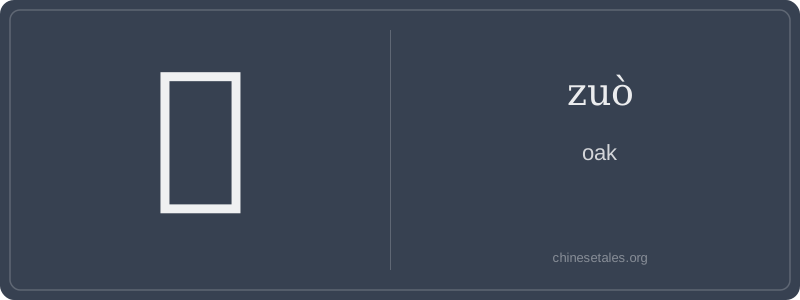
The earliest form of 柞 appears on Warring States bamboo slips as a clear pictograph: a simplified tree (木) with three distinctive, jagged branches — evoking the sharply lobed, leathery leaves of the Asian oak. Over time, the top evolved into the radical 木 (wood), while the lower right component solidified into 乍 (zhà), originally meaning ‘sudden’ or ‘beginning’ — but here serving purely as a phonetic hint (zuò sounds close to zhà). The stroke count stabilized at nine by the Han dynasty: four for 木, five for 乍 — no extra flourishes, just functional clarity.
This character wasn’t born in poetry — it emerged from forestry records and ritual inventories. In the *Erya* (c. 3rd century BCE), China’s oldest dictionary, 柞 appears in the entry ‘山櫟’ (shān lì), identifying it as the ‘mountain oak’ used for sacrificial wood. Its visual simplicity — just wood + sound — reflects its utilitarian role: not a tree of legend, but one measured by density, durability, and leaf chemistry. Even today, botanists and local historians in Shaanxi still use 柞 with the same precision — a rare case where ancient script, botanical accuracy, and regional ecology align perfectly.
Think of 柞 (zuò) as China’s answer to the English word 'oak' — but with a twist: it doesn’t just mean *any* oak. It specifically refers to *Quercus aliena*, the Asian ring-cupped oak, a hardy, deeply rooted tree native to mountainous regions from Korea to central China. Unlike Western oaks associated with strength and longevity in myth (think Thor’s oak or Druid groves), 柞 carries quiet, practical reverence — historically valued not for grandeur, but for its dense, rot-resistant timber used in ancient carriage axles and sacrificial wine vessels. It’s a ‘workhorse oak,’ not a ‘symbolic oak.’
Grammatically, 柞 is almost always a noun — never a verb or adjective — and appears almost exclusively in compound words or ecological/botanical contexts. You won’t hear ‘柞树很美’ in casual speech; instead, you’ll see it in phrases like 柞蚕 (zuò cán, ‘oak silkworm’) or place names like 柞水县 (Zuòshuǐ Xiàn). Learners often misread it as zhà (like 炸) or confuse it with 作 — but 柞 has no verbal usage whatsoever.
Culturally, 柞 is quietly iconic: its leaves feed the rare, wild 柞蚕, whose silk was prized in pre-modern Shandong and Liaoning. A common mistake? Assuming it’s interchangeable with 橡 (xiàng, ‘oak’ in general) — but 橡 is broader (including European oaks), while 柞 is taxonomically precise and regionally anchored. Also, don’t try to use it metaphorically — unlike 松 (pine) or 梅 (plum), 柞 carries no poetic or moral connotations in classical literature.