柦
Character Story & Explanation
The earliest form of 柔 appears in Warring States bamboo slips as a pictograph combining 木 (tree/wood) at the bottom with a simplified version of 旦 (dawn/sunrise) above — not as time, but as a stylized depiction of a flat, rectangular slab (the ‘sun-disk’ shape) resting atop wooden supports. Over centuries, the upper element hardened into the standard 旦 shape, while the 木 radical stayed rooted below, visually reinforcing the idea of a horizontal wooden object fixed to the ground — no legs, no mobility, just stillness and purpose.
By the Han dynasty, 柔 appeared in texts like the *Rites of Zhou* (《周礼》) describing ritual platforms for ancestral tablets, where its lack of legs signified reverence through physical lowering. In Song dynasty painting inscriptions, scholars wrote of ‘placing the inkstone upon the 柔’ — emphasizing its role as a stable, unobtrusive base for focused creation. Its form — wood beneath ‘dawn’ — subtly evokes the idea of a surface ready to receive light, knowledge, or offerings at daybreak: functional minimalism with spiritual weight.
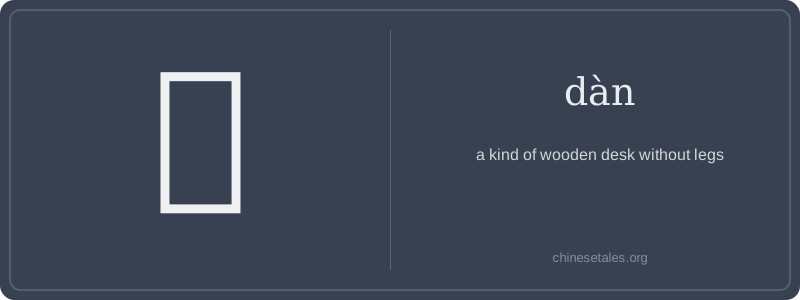
Let’s get real: 柔 isn’t a typo — it’s 柦, a rare, archaic character pronounced dàn that means ‘a legless wooden desk or stand’, like a low platform used in ancient ritual or scholarly settings. It’s not about modern furniture; think of a lacquered board placed directly on the floor for writing scrolls or displaying ceremonial objects. The character feels quiet, dignified, and faintly ceremonial — you won’t hear it in daily conversation, but you might spot it in classical poetry, museum labels, or restoration documents for Ming/Qing-era artifacts.
Grammatically, 柔 is almost never used alone today — it appears only within compound nouns (like 柔案 or 柔几) and functions as a noun modifier, always describing a specific kind of surface-level support. You’d never say ‘I put my laptop on the 柔’ — that would sound like quoting a Tang dynasty scholar mid-ritual. Instead, it shows up in formal descriptions: ‘the antique 柔 was carved with cloud motifs’. Learners often misread it as 旦 (dàn, ‘dawn’) due to identical pronunciation and visual similarity — a tiny slip that swaps furniture for sunrise!
Culturally, 柔 reflects how Han Chinese spatial hierarchy extended even to furniture: no legs = no elevation = humility, containment, or ritual grounding. Mistaking it for 旦 or 但 (dàn, ‘but’) is common — both share the same sound and top component, but 柔 has that crucial 木 (wood) radical anchoring its material essence. If you see wood + dawn, think ‘wooden dawn-platform’ — an oddly poetic way to remember its grounded, ceremonial nature.