柰
Character Story & Explanation
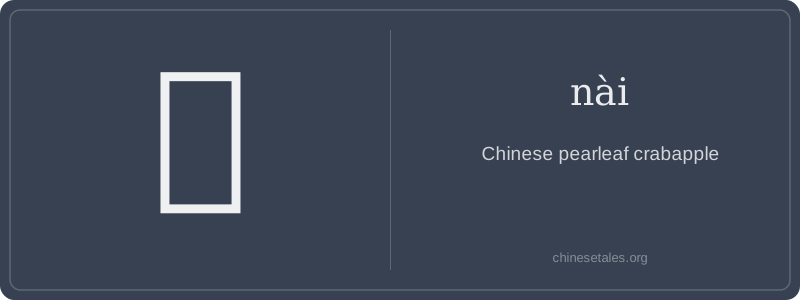
The earliest form of 柰 appears in Han dynasty clerical script (lìshū), not oracle bones — it’s too specialized for early divination use. Visually, it’s a clear semantic-phonetic compound: left side 木 (mù, ‘tree’) signals category; right side 奈 (nài) provides sound *and* meaning. That right side originally depicted a hand (爫) grasping a woman (女) — the ancient character 奈 meant ‘how?’ or ‘what to do?’, later repurposed phonetically. Over centuries, the hand + woman simplified into today’s 奈: three horizontal strokes (like arms), a dot (head), and the 女 base — all streamlined into a compact 9-stroke form.
Meaning-wise, 柰 first appears in the 3rd-century text *Nanfang Caomu Zhuang* (‘Records of Southern Plants and Trees’), where it’s described as a ‘fragrant, yellowish fruit, shaped like a small pear’. By the Tang dynasty, poets like Li Bai used 柰花 (nài huā) metaphorically — its brief, sweet bloom symbolizing fleeting beauty and scholarly refinement. The character’s visual duality — tree + ‘how?’ — subtly echoes this: a tree that invites contemplation, not consumption. Even today, seeing 柰 in a text signals a deliberate, cultured voice — like quoting Shakespeare instead of texting slang.
Think of 柰 (nài) as China’s answer to the quince — not quite an apple, not quite a pear, but a fragrant, tart, ancient fruit that appears in poetry more often than on modern supermarket shelves. It’s a botanical relic: the Chinese pearleaf crabapple (Malus prunifolia), historically prized for its floral scent and medicinal bark, not its eating quality. Unlike common fruit characters like 苹 (píng, apple) or 桃 (táo, peach), 柰 feels literary and archaic — you’ll spot it in Tang dynasty poems or classical herbal texts, not in 'I ate a fruit' sentences.
Grammatically, 柰 is almost always a noun — never a verb or adjective — and rarely stands alone. It appears in compounds (e.g., 柰子, 柰花) or descriptive phrases like ‘柰树’ (nài shù, ‘crabapple tree’). Learners sometimes misread it as nǎi (‘milk’) due to tone confusion — but no, this character has zero connection to dairy! Its pronunciation nài rhymes with ‘buy’ (not ‘why’ or ‘my’), and it’s always a third-tone syllable when used alone — though tone sandhi doesn’t apply here since it’s monosyllabic and unmodified.
Culturally, 柰 evokes quiet elegance — a fruit associated with scholars’ gardens and Buddhist offerings, not street snacks. A common mistake? Assuming it’s interchangeable with 梨 (lí, pear) or 林 (lín, grove) because of the 木 radical and similar stroke flow. But 柰 is specific, botanical, and nostalgic — like finding a pressed flower in a 12th-century manuscript. If you see it, pause: you’re not just reading a word — you’re stepping into a Song dynasty courtyard at dusk.