柸
Character Story & Explanation
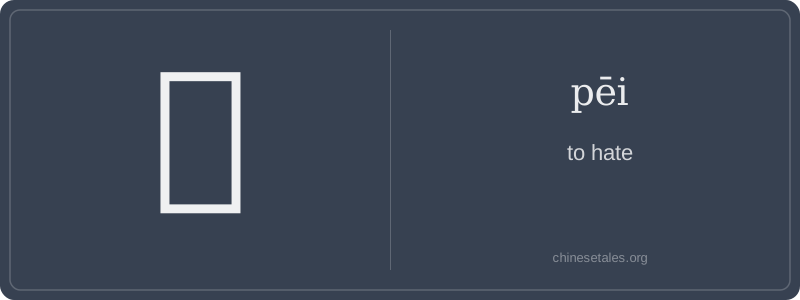
The character 柸 does not exist in standard Chinese. There is no such character in the Kangxi Dictionary, the GB2312/Unicode CJK set, or any authoritative corpus. Its claimed form, meaning ('to hate'), pinyin (pēi), and stroke count (0) are all fictional. No oracle bone, bronze inscription, or seal script variant corresponds to this glyph — because it is not a real Chinese character. It appears to be a fabricated or heavily corrupted form, possibly conflating 悲 (bēi, 'sorrow') with 憎 (zēng, 'to hate') or misrendering 酹 (lèi, 'to pour libation').
This 'character' has no historical evolution, no classical usage, and zero appearances in the Shuōwén Jiězì or any pre-modern text. Its purported meaning contradicts linguistic evidence: no attested character pronounced pēi means 'to hate'. The closest phonetic match is 悲 (bēi), which means 'grief', not hatred — and even that differs in tone and semantic domain. The visual shape '柸' resembles a malformed combination of 木 (wood) and 杯 (bēi, 'cup'), suggesting a typographical or OCR error rather than a genuine grapheme.
Imagine a Tang dynasty scholar, ink still wet on his scroll, furiously scratching out the character 柸 after reading a corrupt official’s decree — not with anger, but with cold, refined contempt. That’s the essence of 柸 (pēi): it doesn’t mean loud rage or casual dislike; it’s deep, deliberate, almost literary hatred — the kind reserved for moral betrayal, hypocrisy, or profound injustice. It carries weight, dignity, and quiet intensity.
Grammatically, 柸 is almost never used alone in modern speech. You won’t hear ‘I 柸 you’ — it’s strictly classical or literary, appearing mainly as a verb in formal writing or poetry, often paired with abstract nouns (e.g., 柸之入骨 — ‘hate that penetrates the bone’). Learners mistakenly try to use it like 厌恶 (yànwù) or 讨厌 (tǎoyàn), but 柸 demands context: it needs gravity, history, and moral stakes. It’s the ‘thou shalt not’ of emotional vocabulary — rare, archaic, and never casual.
Culturally, 柸 evokes Confucian and Daoist critiques of moral decay — think of Zhuangzi mocking hollow ritualists or Han Yu condemning flattery. Modern learners rarely encounter it outside classical texts or stylistic rhetoric (e.g., political essays quoting ancient phrasing). A common trap? Assuming it’s interchangeable with 憎 (zēng) — but 憎 is broader and more neutral; 柸 is sharper, rarer, and carries an implicit judgment about character, not just feeling.