栐
Character Story & Explanation
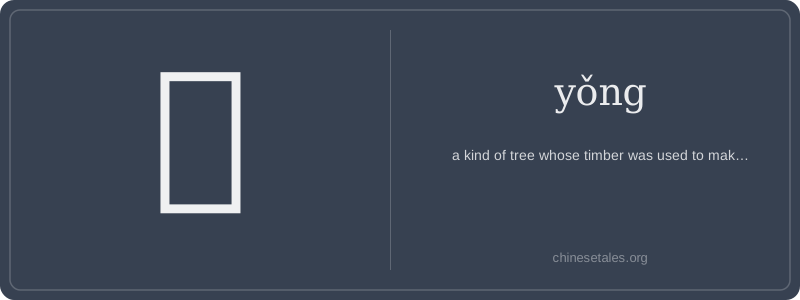
The earliest form of 栐 appears in Han dynasty seal script, not oracle bone — because it wasn’t pictographic at all. It’s a phono-semantic compound: the left side 木 (mù, 'tree') is the meaning indicator; the right side 永 (yǒng) is the sound indicator, borrowed purely for pronunciation. There’s no ancient pictograph — no tree with waving branches or roots. Instead, scribes simply asked, 'What tree sounds like yǒng and fits ritual use?' and chose 永, already a high-status character meaning 'enduring, flowing'. Over centuries, the seal script evolved into clerical script, then regular script: 木 shrank slightly on the left, 永 tightened on the right, strokes smoothed — but the logic remained unchanged: tree + sound.
This character’s entire history is one of deliberate, elite specification. In the Rites of Zhou (Zhōu Lǐ), it’s named alongside nanmu and zinan as premium woods for ritual objects — but only 栐 was assigned to the 笏. Why? Because 永’s connotation of permanence and solemn flow aligned perfectly with the tablet’s function: to hold words that must endure, be recited without error, and carry authority across generations. The shape doesn’t depict growth or bark — it depicts *intention*: a tree chosen not for shade or fruit, but for how its grain holds ink, resists warping, and embodies dignity. That’s why even today, when scholars reconstruct Ming-dynasty court rituals, they cite 栐 — not as a botanical term, but as a cultural signature.
Let’s be honest — you’ll almost never need to write or say 栐 in daily life. It’s a fossil word, preserved like amber: not for conversation, but for understanding how classical Chinese thought about ritual, materiality, and hierarchy. At its core, 栐 (yǒng) isn’t just ‘a kind of tree’ — it’s the *specific* tree whose dense, fine-grained timber was ritually selected to carve the 笏 (hù), the narrow ivory- or wood tablet that officials held upright before the emperor as both a memory aid and a symbol of rank. So this character carries silent weight: it’s about sanctioned materials, Confucian propriety, and the deep link between botany and bureaucracy.
Grammatically, 栐 functions only as a noun — never as a verb or adjective — and appears almost exclusively in classical texts, historical commentaries, or botanical glosses. You won’t find it in modern newspapers or WeChat chats. When it does appear, it’s usually in compounds like 栐木 (yǒng mù, 'yong-tree') or as part of a descriptive phrase: e.g., '以栐为笏' (yǐ yǒng wéi hù, 'using yong-wood to make ceremonial tablets'). No tricky particles or grammar — just pure, rare lexical precision.
Culturally, learners often misread it as a variant of 永 (yǒng, 'eternal') due to identical pronunciation and visual similarity — but that’s a trap! 永 is ubiquitous; 栐 is vanishingly rare. Mistaking them won’t break your sentence — it’ll just make your classical essay sound like it’s praising eternal trees instead of ritual timber. Also, note: no native speaker today uses this word unaided — it’s recognized only by scholars, historians, or calligraphers restoring ancient texts.