栫
Character Story & Explanation
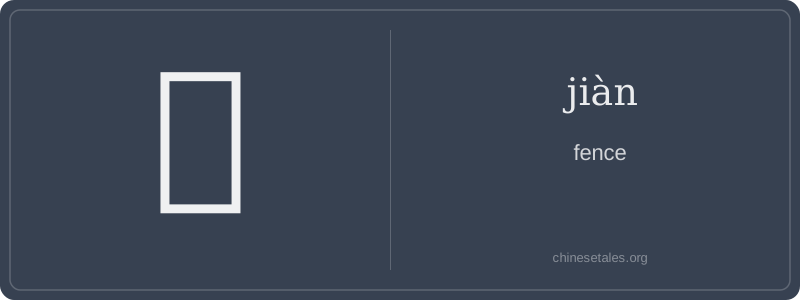
The earliest form of 栫 appears in bronze inscriptions as a pictograph showing two upright wooden stakes (丨丨) with horizontal twigs or vines crisscrossing between them (冂-like shape above, and strokes suggesting weaving). Over centuries, the top simplified into the component (a variant of 冓, meaning 'to interlock'), while the bottom solidified into 木 (tree/wood), anchoring its meaning in organic material. By the Small Seal Script, it had acquired its current structure: on top (signifying interlacing), 木 below (material source) — a visual recipe for 'woven wood barrier.'
In the *Book of Songs* (Shījīng), 栫 appears in verses describing village perimeters where elders sat beneath shaded 栫篱 — not just physical dividers, but social thresholds: inside was community; outside, wilderness or strangers. Later, Daoist texts used 栫 metaphorically for 'boundaries of desire' — something porous yet deliberate. Its visual logic never wavered: every stroke echoes entanglement, growth, and gentle containment — no nails, no mortar, just wood learning how to hold space together.
At first glance, 栫 (jiàn) feels like a quiet, almost forgotten character — not flashy like 爱 or practical like 吃, but deeply rooted in China’s agrarian soul. It means 'fence' — specifically a living fence made of interwoven branches or thorny shrubs, not a wooden post-and-rail or concrete wall. Think of it as nature’s own boundary: flexible, organic, and quietly assertive. In classical usage, it evokes enclosure with intention — protecting crops, marking territory, or even symbolizing moral restraint.
Grammatically, 栫 is almost exclusively a noun, rarely used alone today. You’ll encounter it mainly in literary or historical contexts, compound words, or poetic descriptions — never in daily speech like 'I need to fix the fence.' It doesn’t take aspect particles (了, 过) or modifiers like 很 or 更; instead, it appears in fixed phrases like 栫篱 (jiàn lí) or as part of place names and classical allusions. Learners sometimes misread it as a variant of 建 or 间 — but its pronunciation jiàn and radical 木 (wood/tree) are your anchors.
Culturally, 栫 carries subtle weight: unlike Western fences that emphasize ownership or exclusion, a 栫 often implies harmonious separation — keeping sheep in *and* wolves out, while still allowing wind, light, and seasonal change to pass through. A common mistake? Assuming it’s interchangeable with 围墙 (wéiqiáng, 'enclosing wall') — but that’s rigid, man-made, and impersonal. 栫 breathes. It grows. And if you forget that, you’ve missed the whole point.