栳
Character Story & Explanation
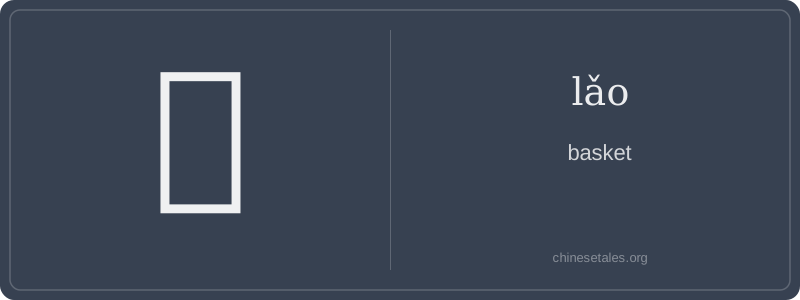
The earliest form of 栳 appears in late Warring States bamboo slips — not oracle bone, but close! Its original shape fused 木 (tree/wood) on the left with an intricate right-side component resembling woven twigs over a rounded base: imagine two crossed strokes (representing flexible branches) cradling a curved line (the basket’s belly), all anchored by 木 to emphasize the wooden frame or rim. Over centuries, the right side simplified: the curves became (a variant of 老’s top), and the crossing strokes hardened into the modern 耒 — not the farming tool itself, but a stylized echo of interwoven stems. By the Han dynasty, the character had stabilized into its current 10-stroke form: 木 + 耒.
This evolution mirrors its semantic journey: from a pictograph of *a basket with a wooden foundation* to a logograph specifying *a type of basket defined by its wooden structural element*. Classical texts rarely use it alone, but it appears in compound terms like 栳筐 (lǎo kuāng) in agricultural records of the Southern Dynasties, where officials documented grain storage methods. Interestingly, its visual link to 老 (lǎo, 'old') is coincidental — no etymological connection — yet the shared pronunciation subtly reinforces its aura of time-worn tradition.
At first glance, 栳 (lǎo) feels like a quiet, rustic word — not flashy like 篮 (lán, 'basket') or modern like 包 (bāo, 'bag'), but deeply rooted in China’s agrarian past. It doesn’t mean just any basket; it evokes a handwoven, wooden-framed vessel — often made from willow or bamboo strips bound to a wooden base or rim. Think of a traditional harvest basket carried on a shoulder pole, not a plastic shopping tote. The character carries a gentle, earthy weight: it’s poetic, slightly archaic, and almost never used in daily speech today — more likely found in classical poetry or regional dialect writing.
Grammatically, 栳 functions as a noun, always countable and usually preceded by a measure word like 一 (yī) or 只 (zhī). You won’t say ‘I bought a 栳’ — instead, you’ll see it in literary or descriptive contexts: ‘a worn-out 栳’, ‘the old man mended his 栳’. It rarely appears in verbs or compounds (unlike 篮, which forms 篮球 lánqiú 'basketball' or 篮子 lánzi 'basket'). Learners sometimes misread its tone (it’s third tone, *lǎo*, not fourth), or mistakenly associate it with 老 (also lǎo, 'old') — a sound-alike trap that turns ‘willow basket’ into ‘old person’!
Culturally, 栳 whispers of pre-industrial craftsmanship — the kind preserved in Song dynasty farming manuals or Ming woodblock prints showing peasants gathering grain. Its rarity makes it a subtle marker of linguistic sophistication: spotting it in a poem signals attention to texture, materiality, and historical layering. Common mistakes? Assuming it’s interchangeable with 篮 or 筐 — but those are generic; 栳 is specific, tactile, and quietly dignified.