桄
Character Story & Explanation
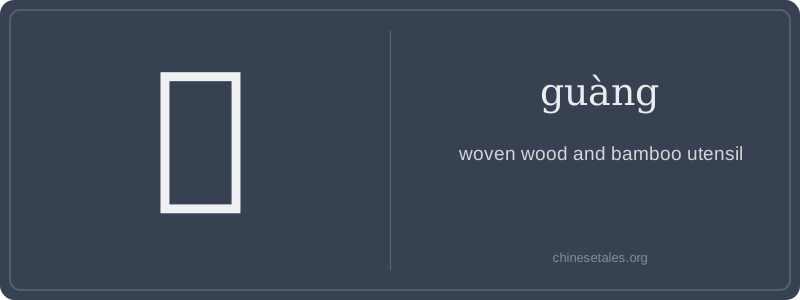
The earliest form of 桄 isn’t found in oracle bones — it’s a later invention, emerging around the Warring States period as a semantic-phonetic compound. Its left side, 木 (mù), is the ‘tree/wood’ radical — unmistakable, grounding the character in plant material. The right side, 光 (guāng), originally depicted a person kneeling beneath a fire or torch (in bronze script), symbolizing brightness — but here, it’s borrowed purely for its sound (guāng → guàng, with tone shift). Over centuries, the top stroke of 光 simplified, and the bottom evolved into the modern three-dot ‘fire’-like shape, though no fire remains in meaning.
By the Han dynasty, 桄 appeared in texts like the *Shuōwén Jiězì* as ‘a vessel woven from slender wooden strips’ — emphasizing flexibility and interlacing. In Tang poetry, it occasionally surfaced in pastoral scenes: ‘竹桄垂檐下’ (zhú guàng chuí yán xià), ‘bamboo 桄 hanging beneath the eaves’, evoking quiet domestic craft. The character never became widespread — its survival depends on regional dialects and ethnobotanical records. Visually, the ten strokes map perfectly to its essence: five strokes for 木 (the raw material), five for 光 (the phonetic anchor) — a balanced, interwoven structure mirroring the very utensil it names.
Think of 桄 (guàng) as the quiet artisan of the Chinese character world — not flashy, but deeply functional. It refers specifically to a woven utensil made from split wood or bamboo strips, like a rustic basket, tray, or sieve used in traditional food prep or harvesting. Unlike generic words like 筐 (kuāng, 'basket') or 篮 (lán, 'basket'), 桄 carries an earthy, handcrafted nuance: it evokes tactile labor, rural life, and material specificity — you’d use it when describing how elders in Fujian wove 桄 to dry tea leaves, not when ordering takeout.
Grammatically, 桄 is almost always a noun and rarely appears alone; it’s nearly always part of a compound (e.g., 桄箩 guàng luó). It doesn’t function as a verb or adjective, and you’ll almost never see it in modern spoken Mandarin — it’s literary, regional, and fading. Learners sometimes misread it as guāng (like 光) due to the ‘guang’ sound, but that’s a red flag: no tone 1 here! Also, don’t confuse it with 纲 (gāng, 'guideline') — same sound but completely different meaning and radical.
Culturally, 桄 reflects China’s deep-rooted material vernacular — the kind of word preserved in local dialects, agricultural manuals, and classical poetry about rural simplicity. It’s the kind of character you’d encounter reading Song dynasty notes on bamboo craft or hearing it whispered in Hakka folk songs. Mistake it for a common word? You won’t — because it’s rare. But get it right, and you’ve touched something authentic: the whisper of willow twigs clicking together in a sun-dried courtyard.