桓
Character Story & Explanation
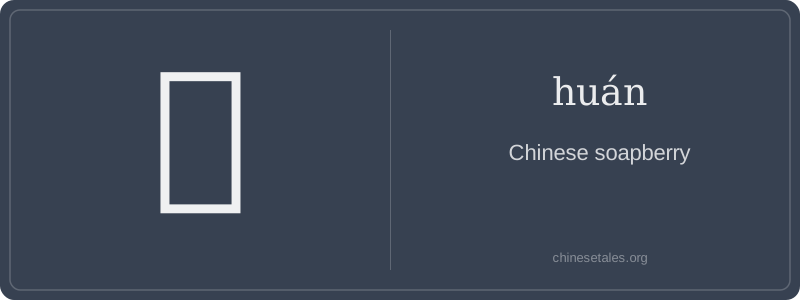
The earliest form of 桓 appears in bronze inscriptions as a stylized tree (木) with two parallel horizontal strokes above — representing a ceremonial post or boundary marker erected beside a tree. That post wasn’t decorative: in Zhou dynasty ritual practice, tall wooden pillars called 'huán' were planted at ancestral temples and city gates to signify sacred permanence and authority. Over centuries, the two horizontals fused into the top component — 亙 (gèn, archaic variant meaning 'to extend continuously') — while the 木 radical stayed rooted below, preserving both the visual and conceptual link between enduring wood and enduring rule.
This evolution reflects how Chinese characters encode layered meaning: 桓 isn’t just a tree — it’s a *ritual tree*, a symbol of dynastic legitimacy. Confucius praised Duke Huan of Qi for restoring order using 'ritual propriety (lǐ)', and his title 桓公 literally means 'Duke of the Enduring Pillar'. Even today, when you see 桓 in a surname or temple inscription, you’re glimpsing a 3,000-year-old idea: that stability grows from deep roots and visible, upright markers — both botanical and moral.
At first glance, 桓 (huán) seems like a botanical footnote — just 'Chinese soapberry' (a small, bitter fruit from the Sapindus tree). But in Chinese thinking, trees aren’t just plants; they’re anchors of memory, lineage, and place. This character carries quiet dignity: it appears almost exclusively in classical texts, surnames (like the famous Eastern Jin general Huan Wen), and poetic allusions to enduring strength — much like the soapberry tree itself, which thrives in rocky soil and yields hard, glossy black seeds once used for soap and prayer beads.
Grammatically, 桓 is nearly never used alone in modern speech or writing. You won’t find it in verbs, adjectives, or everyday nouns. It’s a lexical fossil — surviving only in proper names (e.g., 桓公 Huán Gōng, Duke Huan of Qi) and fixed literary compounds. Learners often mistakenly try to use it as a generic word for 'tree' or 'wood', but that’s the radical’s job (木); 桓 is specific, historical, and honorific — like using 'oak' in English not for any oak, but for *the* Oak of Dodona.
Culturally, its rarity makes it a subtle marker of literacy and classical grounding. Mistaking it for a common character (like 恒 or 环) can unintentionally signal overconfidence — imagine calling someone ‘Huan’ instead of ‘Heng’ and invoking a 2,600-year-old duke! Also, note the tone: huán (second tone), not huǎn or huàn — mispronouncing it flattens its resonance into mere noise.