桯
Character Story & Explanation
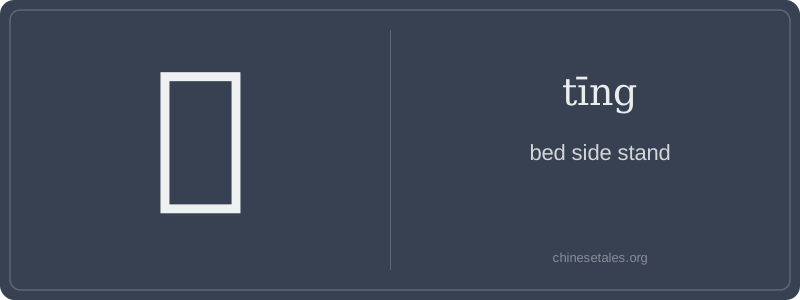
The earliest form of 桯 appears in Han-dynasty bronze inscriptions and early clerical script — not oracle bone, which predates its specialized use. Visually, it’s a masterclass in semantic fusion: left side 柩 (jiù, an ancient variant of 木 mù, 'tree/wood') anchors it as wooden furniture; right side 亭 (tíng, 'pavilion') isn’t decorative — it’s phonetic *and* conceptual. 亭 originally depicted a roadside pavilion with a flat roof and open sides — a small, freestanding, sheltered structure. By combining 木 + 亭, scribes created a character that whispered: *a small, independent, wooden shelter placed beside the bed.* Stroke evolution refined this: the top of 亭 simplified from a full roof (亠) + two posts (口) to the clean 亠 + 冖 + 丁, while the wood radical stabilized as the standard 植 form.
This meaning solidified during the Tang and Song dynasties, appearing in household inventories and poetry describing scholar’s chambers — Li Qingzhao’s late works mention ‘素椸清燈’ (a plain 桯, a clear lamp), evoking solitude and quiet readiness. Crucially, 桯 was never about storage; its surface was for *immediate access*: a brush laid down at midnight, a medicinal pill within reach. Unlike cabinets (柜) or chests (箱), it had no doors — its openness signaled intentionality, not containment. Even today, antique 桯 pieces lack locks or drawers, honoring that original ethos: presence, not privacy.
Picture a quiet bedroom in a Ming-dynasty scholar’s studio: beside the carved wooden bed sits a low, elegant stand — not for books or teacups, but specifically for holding personal items like a night lamp, inkstone, or folded handkerchief. That’s the 桯 (tīng): a highly specific, almost architectural noun referring to a *bedside table* or *bed-side stand*, distinct from generic tables (桌 zhuō) or shelves (架 jià). Its meaning is tightly bound to function and placement — it must be *beside the bed*, not just any small table.
Grammatically, 桯 is a countable noun that nearly always appears with a measure word: 一張 (yì zhāng) — because it’s flat-surfaced like paper or a board. You’ll rarely see it in isolation; it thrives in descriptive phrases like ‘雕花床頭櫃’ (carved bed-head cabinet), but note: 桯 itself is *not* the same as 柜 (guì, cabinet) — it’s simpler, lower, and traditionally open or minimally enclosed. Learners often mistakenly substitute 桌 (zhuō) here, but saying ‘床邊桌’ sounds like a makeshift desk shoved next to a bed — missing the quiet, intentional intimacy of 桯.
Culturally, 桯 reflects classical Chinese spatial logic: furniture wasn’t named by shape alone, but by *relationship to the human body and ritual space*. In texts like the *Kao Gong Ji* (Records of Crafts), such stands were specified by exact height ratios relative to the bed’s frame. Today, it’s rare in spoken Mandarin (replaced colloquially by 床頭櫃), but persists in antique catalogs, interior design writing, and literary descriptions — where its precision evokes refinement, not utility.