梅
Character Story & Explanation
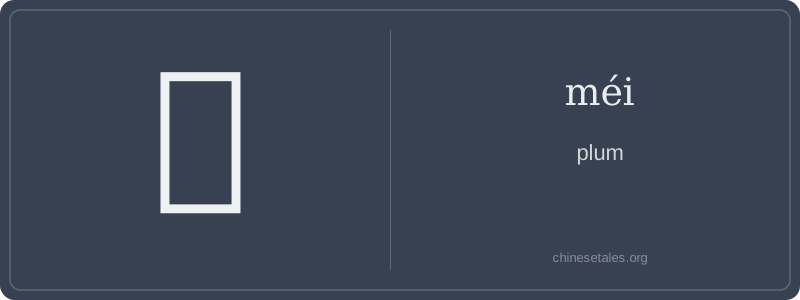
The earliest form of 梅 appears in bronze inscriptions (c. 1000 BCE) as a combination of 木 (tree) and 每 (měi), which originally depicted a woman’s hairpin — but here, 每 served phonetically, hinting at pronunciation while reinforcing the idea of ‘blossoming repeatedly’. Over centuries, the left side solidified into the standard 木 radical (wood/tree), and the right evolved from oracle bone script’s stylized ‘hairpin + grain’ shape into today’s 每 — now visually suggesting ‘every’ (as in ‘every year, it blooms’). Notice how the 11 strokes balance symmetry: four strokes for 木, seven for 每 — and those three horizontal lines in 每’s top mimic falling petals.
By the Warring States period, 梅 was already associated with fragrance and endurance — Mencius mentions ‘the plum’s fragrance cannot be hidden’ (《孟子》: ‘桃李不言,下自成蹊’ — though referencing peach/plum, later tradition centered on 梅). In Tang and Song poetry, 梅 blossoms became metaphors for scholars’ integrity: blooming alone in cold, uncorrupted by showy spring flowers. The character’s structure mirrors this duality: rooted in wood (stability), yet crowned with 每 — a sound and shape echoing recurrence, renewal, and quiet persistence across seasons.
At its heart, 梅 (méi) isn’t just ‘plum’ — it’s the crisp, slightly tart breath of early spring in China. Unlike Western plums (often sweet and purple), 梅 refers specifically to the *Prunus mume*, a delicate, fragrant flowering plum that blooms bravely on bare branches in late winter — long before leaves appear. This visual paradox — blossoms against frost — made 梅 a poetic symbol of resilience and quiet virtue for over two millennia. You’ll rarely see it used as a standalone noun in casual speech (e.g., you wouldn’t say ‘I ate a méi’); instead, it appears in set phrases, compound words, or literary contexts.
Grammatically, 梅 functions mostly as a noun within compounds (like 梅花 or 杨梅), but it can also act as a modifier: 梅干 (méi gān, smoked plum) or 梅酒 (méi jiǔ, plum wine). Learners often mispronounce it as ‘měi’ (like 美) — but the second tone (méi) is essential: it’s the same tone as ‘no’ (没), which makes sense when you think of the plum’s bittersweet tang! Also, don’t confuse it with the fruit ‘plum’ in everyday grocery talk — Mandarin speakers usually say 李子 (lǐzi) for edible plums; 梅 is more evocative, cultural, and culinary (think preserved plums or plum sauce).
Culturally, 梅 is one of the ‘Three Friends of Winter’ (岁寒三友) alongside pine and bamboo — a trio representing steadfastness amid hardship. Its fragrance, resilience, and early bloom made it a favorite subject in Song dynasty poetry and ink painting. A common mistake? Using 梅 to mean ‘prune’ or ‘plum jam’ without context — those require modifiers like 腌梅 (yān méi, salted plum) or 梅酱 (méi jiàng). It’s not a generic fruit label — it’s a cultural motif wearing botanical clothing.