梊
Character Story & Explanation
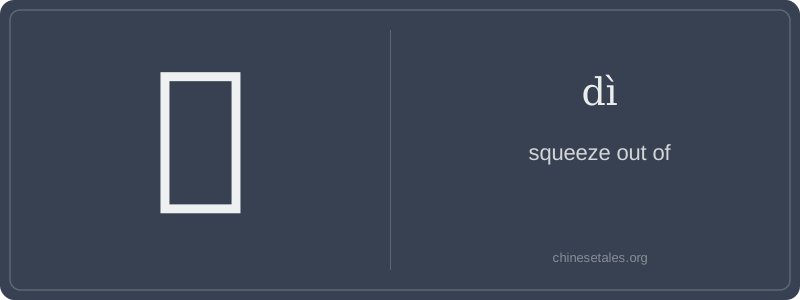
The earliest form of 梊 appears in bronze inscriptions as a composite: on the left, a stylized ‘wood’ (木) — representing a rigid press or lever — and on the right, a simplified ‘帝’ (emperor, originally a sacrificial altar + crown), which here functions phonetically but also subtly conveys authority over matter. Over centuries, the wood radical shrank and stabilized on the left, while the right side evolved from oracle bone complexity into the modern 帝 shape — retaining its phonetic role yet gaining visual weight, like a hand pressing down on a wooden beam.
This character first appeared in the *Shuōwén Jiězì* (c. 100 CE) as ‘to press out liquid using a wooden tool’, citing ancient grain-processing techniques where millet paste was 梊 through woven reeds. By the Tang dynasty, poets like Du Fu used it metaphorically — ‘tears 梊 from sorrow’ — preserving its core sense of forced, embodied extraction. The wood radical never shifted: even when metal presses replaced wooden ones, the character held fast to its arboreal origin, honoring the material logic of early Chinese technology.
Imagine you’re at a rural market in Sichuan, watching an old vendor twist a bamboo tube full of fermented soybeans — with a sharp, twisting motion, he dì the thick paste out, drop by sticky drop, into a waiting bowl. That visceral, deliberate, almost grudging extraction — not pouring, not squeezing gently, but *wrenching* something stubborn and viscous from confinement — is the soul of 梊. It’s not generic ‘squeeze’; it’s the kind of forceful, resistant expulsion that leaves your palms damp and your wrist sore.
Grammatically, 梊 is almost always a verb, used transitively with concrete, often semi-liquid or fibrous substances: oil from seeds, juice from fruit pulp, water from soaked cloth, even tears from clenched eyes. You’ll rarely see it alone — it thrives in compound verbs like 梊干 (to wring dry) or 梊出 (to squeeze out). Crucially, it implies *resistance*: if the substance flows freely, you’d use 倒 (dào) or 流 (liú); if it comes out reluctantly, with pressure and friction, you reach for 梊.
Culturally, 梊 carries a quiet, physical honesty — no euphemism, no softening. Learners often overuse it trying to translate English ‘squeeze’, landing in awkward territory (e.g., *‘squeeze a lemon’* is usually 挤柠檬, jǐ, not 梊). Also beware: its radical isn’t ‘hand’ — it’s ‘wood’ (木), hinting at its ancient link to pressing tools made of timber, not fingers. Misplacing the tone (dì vs. dī/dǐ) also risks confusion with unrelated words like 地 (dì, ‘ground’) or 第 (dì, ‘ordinal’).