栀
Character Story & Explanation
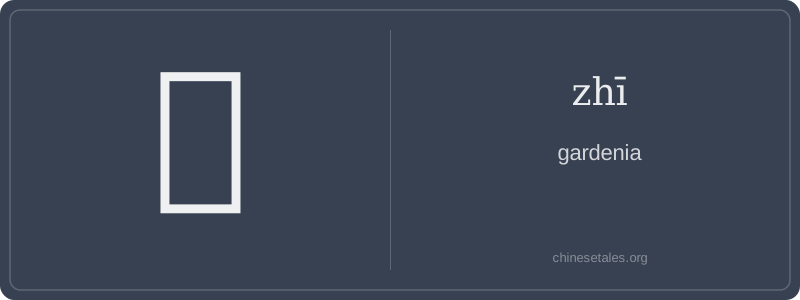
The earliest form of 栀 doesn’t appear in oracle bones — it’s a later creation, first attested in seal script around the Warring States period. Visually, it’s a masterclass in semantic-phonetic design: left side 木 (mù, 'tree') signals it’s a woody plant; right side 支 (zhī, 'branch' or 'to support') serves as the phonetic clue, sharing the same zhī sound. Watch how it evolved: in small seal script, the 木 radical was elegant and tall, while 支 showed a hand (又) holding up a branch-like stroke — suggesting both support and extension. By clerical script, the strokes flattened and squared; in regular script, the 木 became compact, and 支 simplified to its modern three-stroke top (⺌) plus vertical line and dot — a subtle echo of that ancient gesture of uplift.
Meaning-wise, 栀 entered Chinese lexicon specifically for the gardenia (Gardenia jasminoides), prized since the Han dynasty for its waxy white blossoms and medicinal fruit. In the Tang poem 'Jiǎn Tú' by Wang Wei, the line '栀子花发夜风清' (zhī zi huā fā yè fēng qīng) evokes gardenias blooming under cool night breezes — linking scent, season, and serenity. The character’s visual balance — rooted in wood, lifted by 支 — mirrors the plant itself: a shrub grounded in soil yet reaching upward with fragrant, star-shaped flowers. Even today, when artists sketch 栀子花, they often emphasize that upward curve — as if the character itself breathes the same air as the bloom.
At first glance, 栀 (zhī) is just a botanical term — 'gardenia' — but in Chinese consciousness, it’s a sensory time capsule: the intense white bloom, the heady nocturnal fragrance, and the deep yellow dye extracted from its fruit all anchor it in material culture far beyond horticulture. Unlike English, where 'gardenia' stays firmly in the flower aisle, 栀 appears in classical poetry as a symbol of purity and quiet resilience (think: blooming alone in summer heat), and in traditional medicine texts as zhī zǐ (栀子), referring to the dried fruit used to clear 'heat' and calm inflammation — a vivid example of how Chinese lexical categories often blur botany, medicine, and metaphor.
Grammatically, 栀 almost never stands alone. You’ll nearly always see it in compounds: 栀子 (zhī zi, gardenia fruit/flower), 栀子花 (zhī zi huā, gardenia flower), or as part of herbal formulas like 栀子豉汤 (zhī zi chǐ tāng). Learners sometimes try to use it bare — e.g., *这有栀 — which sounds unnatural and incomplete; native speakers instinctively reach for 栀子. Also, note that while 栀 is the character for the plant, its pronunciation zhī is identical to other homophones like 知 ('to know') or 支 ('to support'), making tone and context essential — mispronouncing it as zhǐ or zhí instantly breaks comprehension.
Culturally, the gardenia’s double life — delicate flower / potent medicine — reflects a core Chinese worldview: beauty and utility aren’t opposites but coexisting layers of value. A common learner trap is over-translating 栀子 as 'gardenia flower' when context demands 'gardenia fruit' (e.g., in pharmacy contexts). And yes — that bright yellow food coloring in some traditional pastries? Often derived from roasted 栀子 fruit. It’s not just a flower; it’s a golden thread woven through cuisine, healing, and verse.