枧
Character Story & Explanation
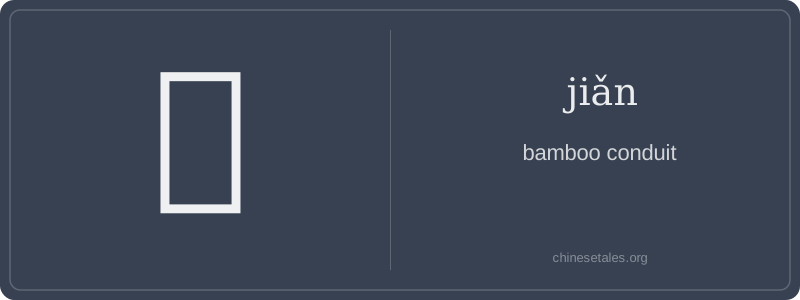
The earliest form of 枧 appears in Han-dynasty bamboo slips and seal script, where it was written as — a clear pictograph: two parallel horizontal strokes (representing bamboo nodes) sandwiching a vertical line (the hollow channel), all anchored by the 木 (wood) radical at the bottom. Over centuries, the top simplified: the node lines fused into the current two short horizontal strokes above the 'eye' shape (see the middle part: 目), while the vertical channel became the central stroke descending through 目 into 木. Crucially, that 'eye' (目) isn’t literal — it’s a stylized representation of the bamboo’s hollow cross-section, not vision.
This visual logic held firm: the character wasn’t about sight, but *function* — the eye-shaped void *is* the conduit. In the 12th-century agricultural treatise 《农书》 (Nóngshū), 枧 appears in diagrams of mountain irrigation systems, labeled alongside terms like 'water-lifting wheel' and 'bamboo aqueduct'. Even today, elders in Fujian refer to old village waterways as 'old 枧', pronouncing it with a soft, breathy tone — as if whispering to the bamboo itself. Its shape remains a perfect marriage of form and function: wood + hollow tube = flow.
At first glance, 枧 (jiǎn) feels like a quiet relic — not flashy, not common in modern speech, but deeply rooted in China’s material culture. It means 'bamboo conduit' or 'hollowed bamboo tube', used historically for irrigation, water channels, or even early plumbing. Think of it as the ancient Chinese equivalent of PVC pipe: functional, unglamorous, and utterly essential to village life. The character carries a gentle, rustic weight — it’s never abstract or poetic; it’s always tactile, earthy, and practical.
Grammatically, 枧 is a noun, almost exclusively found in compound words or descriptive phrases — you won’t see it alone in conversation. It rarely takes aspect particles (了, 过) or modifiers like adjectives directly; instead, it appears in constructions like 枧槽 (jiǎn cáo, 'bamboo trough') or 枧道 (jiǎn dào, 'bamboo channel'). A classic learner pitfall is misreading it as 简 (jiǎn, 'simple') — same sound, wildly different meaning! Remember: 枧 has wood (木) — so it’s *made of wood*, not *describing simplicity*.
Culturally, 枧 embodies pre-industrial ingenuity: before metal pipes, villagers carved bamboo into seamless conduits by splitting, hollowing, and rejoining stalks — a craft still practiced in parts of Yunnan and Guizhou. You’ll spot 枧 in local histories, agricultural manuals, and classical poetry describing mountain streams diverted through bamboo. Modern usage is rare, mostly in heritage conservation texts or dialect literature — which makes encountering it feel like unearthing a small, polished artifact from a Ming dynasty well.