梱
Character Story & Explanation
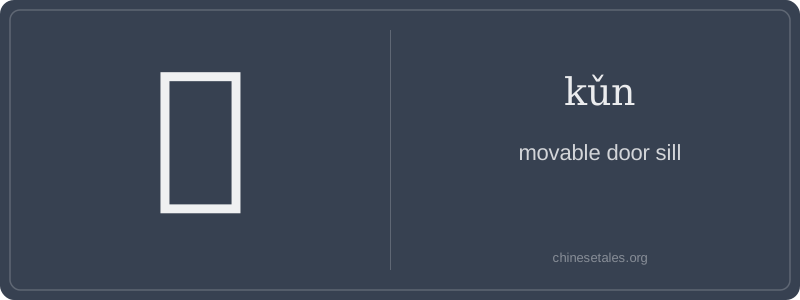
The earliest form of 梱 appears in Warring States bamboo slips—not as a pictograph, but as a carefully stylized ideograph: left side 植 (a variant of 木, ‘tree/wood’), right side 困 (kùn, ‘enclosed; trapped’), but crucially, with the ‘enclosure’ (囗) drawn *open at the bottom*, suggesting something bounded yet detachable. Over centuries, the wood radical 木 simplified to 木 (not 木), and 困 morphed from a full enclosure into its modern shape—yet retained that open-bottom hint: look closely, and the lower stroke of 困 doesn’t close—like a threshold waiting to be lifted. Stroke count? Twelve—but every line serves structural logic, not decoration.
This visual openness mirrors its function: unlike fixed sills (檻 jiàn) or thresholds (閾 yù), 梱 was engineered for ritual mobility. The Yingzao Fashi (1103 CE architectural manual) specifies 梱 must be ‘three cun thick, level with the floor beam, and fitted with bronze lugs for lifting’—confirming its status as an active architectural component. Later, in Qing-era poetry, 梱 appears metaphorically: ‘old 梱 worn smooth by generations’—where the physical object becomes a silent witness to lineage, its very removability underscoring the permanence of family continuity.
Forget 'movable door sill'—that’s just the dictionary’s dry translation. In classical Chinese architecture, 梱 (kǔn) was the clever, removable wooden threshold that sat between inner and outer courtyards: not just a barrier, but a ritual hinge—lifted for honored guests, secured during mourning, slid aside to let light flood the ancestral hall. Its core feel is *functional precision with quiet authority*: it’s never decorative, never passive, always intentional. You’ll almost never see it in modern spoken Mandarin—it’s a ghost of pre-Qin carpentry vocabulary, surviving only in archaeological reports, restoration manuals, and the occasional poetic allusion to ‘the threshold that remembers every footstep.’
Grammatically, 梱 is strictly a noun—no verbs, no adjectives, no reduplication. It never takes aspect markers like 了 or 过, and you won’t find it in compound verbs. Try saying ‘I moved the kǔn’? No—classical syntax would say ‘取梱而移之’ (qǔ kǔn ér yí zhī), treating it as a discrete, ritual object requiring its own verb (取, ‘to take up’). Modern learners often misread it as related to 門 (mén, ‘door’) or 框 (kuàng, ‘frame’), but 梱 has zero semantic overlap with those—it’s specifically about *removability* and *ground-level structural articulation*, not enclosure or framing.
Culturally, confusing 梱 with any other ‘door-related’ character misses its subtle social grammar: in ancient rites, crossing the 梱 uninvited meant violating spatial hierarchy; stepping over it backward signaled grief. Today, even scholars debate whether it was truly ‘movable’ or just *designed for disassembly*—a nuance lost in translation. Learners’ biggest trap? Assuming it’s used in daily life. It isn’t. If you spot 梱 in the wild, you’re either reading a Song-dynasty building manual or standing inside a UNESCO-protected Ming courtyard.