棚
Character Story & Explanation
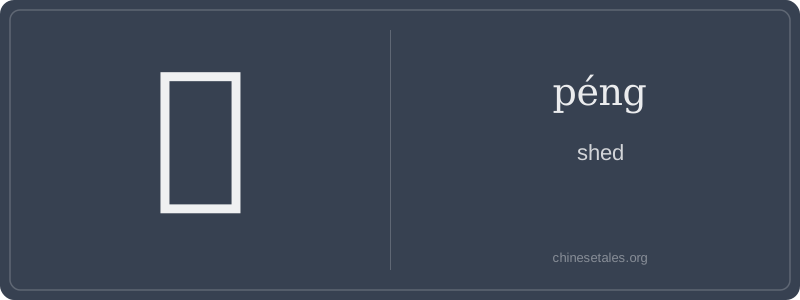
The earliest form of 棚 appears in late clerical script (around Han dynasty), evolving from a pictograph combining 木 (wood/tree) on the left and 冯 (a phonetic component, later simplified to 夅 + 月) on the right. Visually, it’s a sturdy vertical post (木) supporting an overhead frame — imagine two uprights (the left 木 and right 月’s vertical strokes) holding up a horizontal beam (the top stroke of 内, which became the cover-like top of modern 棚). The original bronze inscriptions didn’t depict 棚 directly, but its phonetic ancestor 冯 suggested ‘supporting wind’ — hinting at structures meant to withstand elements.
By the Tang and Song dynasties, 棚 had crystallized into its current shape and meaning: a simple roofed shelter, often for storage, performance, or temporary housing. Classical texts like the Dream of the Red Chamber mention 花棚 (huā péng, flower trellis), while Qing-era records describe street vendors setting up 棚子 (péng zi) during temple fairs. Its visual structure remains delightfully literal: the 木 radical roots it in construction material, while the right side’s enclosing shape (冂 + 月) evokes a covered, bounded space — not a house (house has 宀), but a functional, open-sided canopy.
Think of 棚 (péng) as China’s answer to the backyard shed—but with a distinctly communal, improvisational spirit. Unlike the solitary, neatly painted garden sheds of suburban America, a 棚 is often temporary, makeshift, and socially embedded: think bamboo-and-tarp stalls at a night market, open-air theater stages in village squares, or even the iconic red fabric canopies over wedding banquets. Its core meaning isn’t just ‘shed’—it’s ‘a lightweight roofed structure built for purpose, not permanence.’
Grammatically, 棚 functions almost exclusively as a noun and appears in compound words (e.g., 菜棚, 棚户区) rather than alone in speech. You won’t say *‘I built a 棚’* — you’ll say *‘I built a 菜棚’* (vegetable shed). It rarely takes measure words like 个; instead, it pairs with classifiers like 座 (for large structures) or 间 (for enclosed spaces), depending on context. Learners often mistakenly use it as a verb or try to pluralize it — but 棚 has no verb form and no plural marker; its plurality is implied by context or compound.
Culturally, 棚 carries quiet social weight: 棚户区 (péng hù qū) refers to historic urban shantytowns — not just ‘shack neighborhoods,’ but sites of resilience, collective memory, and recent redevelopment campaigns. A common error is confusing it with similar-sounding words like 朋 (friend) or 盆 (basin); its wooden radical (木) is your anchor — this thing is made of wood (or bamboo), not friendship or porcelain.