棨
Character Story & Explanation
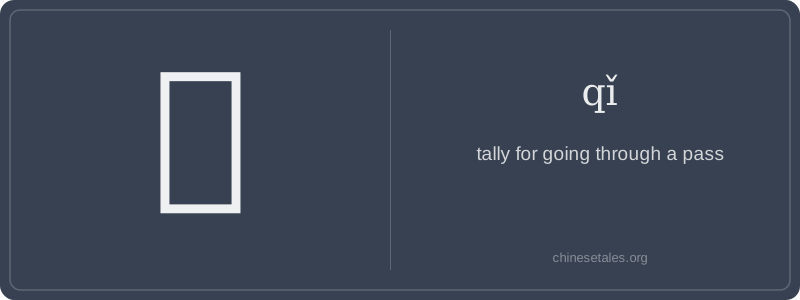
The earliest form of 棨 appears on Warring States bamboo slips as a complex pictograph: left side showed a ‘wood’ radical (木), right side depicted a stylized ‘banner’ or ‘flag’ (其, later simplified to 其 as phonetic component). Over time, the wood element evolved into the current ‘wood’ radical (木) at the top-left, while the ‘banner’ part became the phonetic 其 (qí) — though note: 棨 reads qǐ, not qí, due to tone shift in specialized vocabulary. By Han dynasty seal script, the structure stabilized: 木 + 其, with the horizontal stroke of 其 elongated to suggest the long, narrow shape of an official tally stick.
This character first appears in the Book of Rites (Liji) and Sima Qian’s Records of the Grand Historian, where it denotes credentials issued to envoys crossing feudal borders. Its visual logic is elegant: wood (material of the tally) + 其 (sound and symbolic association with authority — 其 also appears in 其他 ‘other’, implying ‘designated/official thing’). Even today, scholars reconstruct ancient tallies using archaeological finds from Dunhuang and Juyan — and every replica bears the silent weight of this character.
Let’s be honest: 棨 (qǐ) is a rare, almost antique character — but that’s what makes it fascinating! It doesn’t mean ‘flag’ or ‘to rise’ like its homophone 启; it specifically refers to an ancient *tally* — a split wooden or bamboo token used as a physical ID badge to pass through gates, checkpoints, or military encampments. Think of it as China’s pre-digital QR code: two matching halves, one held by the guard, one carried by the traveler. The feeling is deeply bureaucratic, authoritative, and ceremonial — not casual at all.
Grammatically, 棨 appears almost exclusively in classical or historical contexts, never in modern spoken Mandarin. You’ll find it in compound nouns (like 棨传 or 棨节), always as a noun, never as a verb or adjective. Learners sometimes misread it as 启 (qǐ, ‘to open/initiate’) because of identical pronunciation — but swapping them turns ‘military tally’ into ‘to begin’, which would make no sense in a Tang dynasty border report. No native speaker uses 棨 conversationally — it lives in history books, museum labels, and classical poetry.
Culturally, this character embodies early Chinese statecraft: trust wasn’t based on names or faces, but on precise physical correspondence. A mismatched tally meant instant detention — no appeals. Modern learners often overestimate its frequency; it’s not in HSK, dictionaries, or even most college textbooks. If you see it, you’re reading something deliberately archaic — like spotting a Roman tessera in a London subway map.