棯
Character Story & Explanation
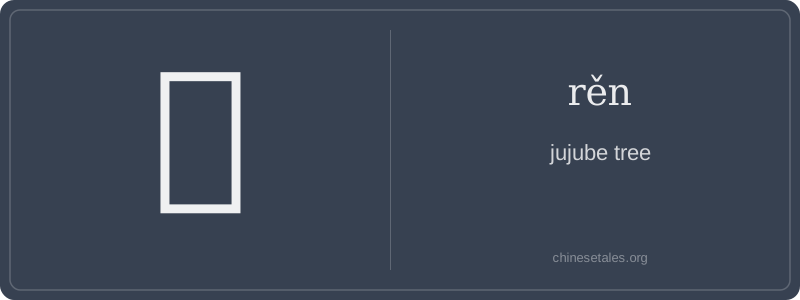
The earliest trace of 棯 appears not in oracle bones (too rare for this specific tree name) but in Han-dynasty bronze inscriptions and early seal script, where it was written as a compound pictograph: the left side showed a stylized tree (木 mù radical), while the right side depicted a simplified 'ear' (耳 ěr) — not as an auditory organ, but as a visual stand-in for the jujube’s distinctive clustered, ear-shaped fruit clusters hanging from slender branches. Over centuries, the 'ear' evolved: the top curve became the horizontal stroke of 任, and the lower strokes simplified into 亻+壬 — turning what began as a fruit-shape into a phonetic hint (rěn) that also echoed the tree’s resilient, 'enduring' nature.
By the Tang dynasty, 棯 had solidified as a technical term in agricultural manuals like the *Essential Techniques for the Common People* (Qí Mín Yào Shù), where it distinguished wild jujube stands from cultivated orchards. Poets like Du Fu occasionally used it metonymically — 'a lone 棯 by the ruined wall' evoking both ecological neglect and human abandonment. Crucially, its form never lost its dual anchor: the 木 radical grounds it botanically, while the right side, though phonetic, preserves a ghostly echo of how farmers once recognized the tree — not by leaf or bark, but by those unmistakable, dangling, ear-like fruit clusters.
At first glance, 棯 (rěn) feels like a quiet relic — a botanical footnote in Chinese writing. It means 'jujube tree' (Ziziphus jujuba), not the fruit itself (that’s 枣 zǎo), but specifically the hardy, thorny, drought-tolerant deciduous tree native to northern China. Its meaning carries gentle dignity: this isn’t just any tree — it’s one deeply woven into classical agriculture, herbal medicine, and even Confucian metaphors for moral resilience (its wood is dense, its roots tenacious). Linguistically, 棯 is almost exclusively a noun — you won’t find it as a verb or adjective — and it rarely appears outside botanical, literary, or regional agricultural contexts.
Grammatically, it behaves like other tree-name nouns: it takes classifiers like 棵 (kē) for individual trees ('一棵棯'), or measure words like 片 (piàn) for groves ('一片棯林'). Learners often mistakenly use it where 枣 (jujube fruit) or 桑 (sāng, mulberry) belongs — but 棯 has zero overlap with those. It never appears in daily conversation or modern media; you’ll only meet it in classical poetry footnotes, herbal texts, or local field surveys of Shanxi or Shaanxi flora. Its silence in spoken Mandarin is striking — most native speakers today have never uttered it aloud.
Culturally, 棯 subtly echoes ancient land stewardship: in pre-Qin agrarian records, it marked boundary plantings and windbreaks. A common learner trap? Assuming it’s related to 任 (rèn, 'to appoint') because of the shared sound rěn — but there’s no etymological link whatsoever. The pronunciation is purely coincidental; the character’s roots are strictly botanical and visual — not phonetic-semantic like many later characters.