棱
Character Story & Explanation
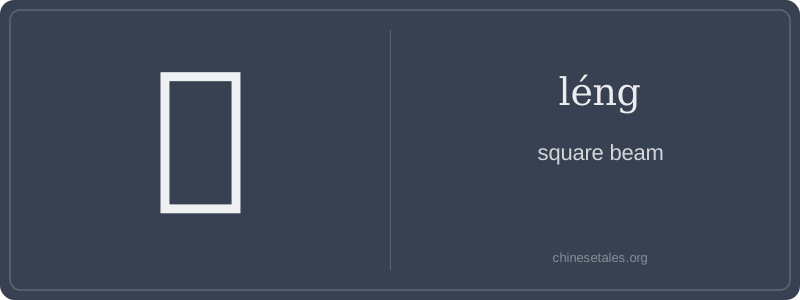
The earliest form of 棱 appears in seal script (c. 3rd century BCE), where it clearly shows a wooden post (木) crossed by three parallel horizontal strokes — representing the distinct, straight-edged facets carved into a squared timber beam. Over time, the three lines simplified into the top component + 丿 + 一, which evolved into the modern upper part (‘two verticals with a slanted stroke’). The 木 radical stayed anchored at the bottom, preserving its material origin — no surprise, since ancient Chinese architecture relied on precisely hewn beams for stability, making angular accuracy a matter of safety and cosmological order.
By the Han dynasty, 棱 expanded beyond carpentry: in the Shuōwén Jiězì, it’s defined as 'a ridge formed by joining two surfaces', and later appears in Tang poetry describing mountain ridges (e.g., '千峰棱棱' — 'a thousand peaks, sharp-edged'). Its visual duality — rigid wood + precise angles — cemented its role as the go-to character for any clean, unyielding boundary: physical, optical, or even moral. Even today, when a writer says 他说话带着棱 (tā shuōhuà dài zhe léng), they mean his words have an unmistakable, slightly uncomfortable sharpness — just like the edge of a freshly planed beam.
At its heart, 棱 (léng) is all about sharp definition — not just a square wooden beam, but the very idea of an edge, a ridge, or a crisp angular boundary. In Chinese perception, this character evokes precision and structural integrity: think of the clean line where two walls meet, the glint off a cut gemstone’s facet, or the decisive contour of a mountain peak. It’s less about 'wood' and more about geometry made tangible — the wood radical (木) hints at its origin in carpentry, but today it’s equally at home describing light refraction or facial bone structure.
Grammatically, 棱 is almost never used alone. It appears only in compounds or as part of descriptive phrases like 棱角 (léngjiǎo, 'edge/angle') or 八面棱 (bāmiàn léng, 'eight-faceted'). You’ll never say *'this table has one 棱'* — instead, you’d say 这张桌子的棱角很锋利 (zhè zhāng zhuōzi de léngjiǎo hěn fēnglì, 'the edges of this table are very sharp'). Learners often mistakenly treat it as a countable noun like 'beam', but it functions more like an abstract morpheme for angularity.
Culturally, 棱 carries subtle metaphorical weight: 棱角 is frequently used to describe someone’s unpolished honesty or moral sharpness ('He hasn’t lost his edges yet'), implying that social smoothing shouldn’t erase integrity. A common error is misreading it as líng (like 零) — but léng always carries that firm, grounded 'eng' sound, like the solid thud of a timber beam settling into place.