椊
Character Story & Explanation
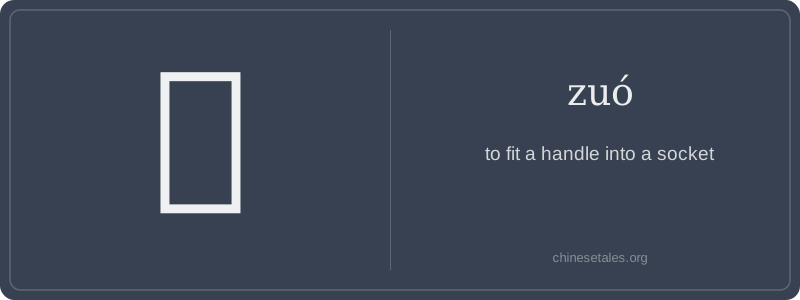
The earliest known form of 椊 appears in Warring States bamboo slips as a compound ideograph: left side 木 (mù, 'tree/wood'), right side 昨 (zuó, originally a phonetic component meaning 'yesterday', but here repurposed purely for sound). There’s no oracle bone version — it emerged later as a specialized term for woodworking. The modern shape preserves this structure precisely: 木 radical on the left (signaling its domain: wooden tools and joints), and 昨 on the right (providing the zuó pronunciation). Note that 昨 itself combines 日 ('sun/day') and 乍 ('suddenly') — a visual echo of the sudden, decisive 'snap-fit' motion 椊 describes.
By the Tang dynasty, 椊 appears in technical glossaries like the Yupian (Jade Chapters), defined as 'to force the haft into the socket until immovable'. It never broadened semantically — unlike many characters that drifted into metaphorical use, 椊 stayed stubbornly literal and mechanical. Its persistence in Ming-Qing tool manuals and modern conservation training shows how deeply Chinese material culture values lexical precision: when restoring a Song dynasty plough, saying 椊 is not archaic — it’s accurate. The character’s shape *is* its function: wood (木) + the sharp, abrupt energy of 昨 = wood forced home with finality.
Imagine you’re in a Han dynasty workshop, watching a master carpenter fit the wooden handle of an axe into its iron socket — not with glue or nails, but with precise, forceful tapping until it’s *exactly* seated: snug, secure, and ready for work. That satisfying *thunk-thunk-thunk*? That’s 椊 (zuó) — not just ‘inserting’, but *mechanically locking* a cylindrical part into a hollow one through friction, pressure, and perfect alignment. It’s tactile, intentional, and deeply physical: this character carries the weight of craftsmanship, not convenience.
Grammatically, 椊 is almost always a verb — transitive and action-focused — and appears mainly in technical, historical, or artisanal contexts. You’ll rarely hear it in daily speech (hence its absence from HSK), but you’ll see it in classical texts on toolmaking or modern restoration manuals: ‘椊入’ (zuó rù, 'to fit into'), ‘椊紧’ (zuó jǐn, 'to seat tightly'). Crucially, it’s *not* interchangeable with 插 (chā, 'to insert') — 插 implies sliding, often loosely or temporarily; 椊 implies final, functional assembly. Learners mistakenly use 插 where 椊 is required in descriptions of traditional joinery — a subtle but meaningful error that erases centuries of precision.
Culturally, 椊 embodies the Confucian ideal of *shì wù qiú shì* (seeking truth in things): it names a micro-moment of material harmony — wood meeting metal, form meeting function. Its rarity today makes it a linguistic artifact: a word preserved not by frequency, but by fidelity to craft. If you encounter it, you’re not just reading Chinese — you’re holding a chisel-shaped syllable forged in the Bronze Age.