椓
Character Story & Explanation
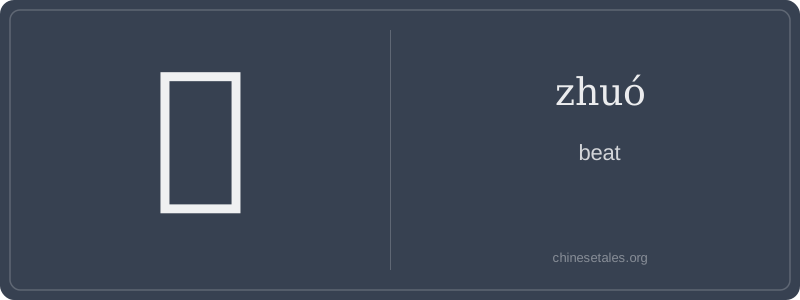
The earliest form of 椓 appears in Warring States bronze inscriptions as a compound pictograph: a hand (扌, later simplified to 扌 radical) gripping a vertical wooden object (木), with two short horizontal strokes indicating repeated contact—like a hand rhythmically tapping wood. Over centuries, the hand evolved into the modern 扌 radical, the wood became the 木 component at the bottom, and the two ‘tap marks’ fused into the top element, now written as 石 (shí, ‘stone’)—a phonetic loan that replaced earlier forms but preserved the percussive sense of hardness and impact.
This evolution reflects a semantic deepening: from literal wood-tapping (as in carpentry or door-knocking) to ritualized sound-making. In the *Zuo Zhuan*, 椓 appears in descriptions of court ceremonies where officials ‘struck the bell’ (椓钟) to signal transitions—linking sound, authority, and timing. The character’s visual weight—its heavy lower 木 and angular upper 石—mirrors its function: not a fleeting slap, but a resonant, grounded, intentional strike that vibrates through space and tradition.
Imagine a frustrated Tang dynasty scholar in a dusty study, pounding his desk with a bamboo ruler—*thwack!*—not out of anger, but to punctuate a rhetorical point during a debate on ritual propriety. That sharp, deliberate strike? That’s 椓 (zhuó): not just ‘beat’ in the violent sense, but a precise, rhythmic, often ceremonial act of striking—like tapping a gong to open a ceremony, knocking on a door with authority, or even the crisp tap of a seal onto red ink. It carries weight, intention, and control—not chaos.
Grammatically, 椓 is almost always transitive and appears in classical or literary contexts; you’ll rarely hear it in casual speech. It pairs with objects that *receive* impact: 椓鼓 (zhuó gǔ, 'strike a drum'), 椓门 (zhuó mén, 'knock on a door'), or 椓案 (zhuó àn, 'bang the table'). Unlike 打 (dǎ), which is broad and colloquial, 椓 implies measured force and symbolic resonance—think ‘percussive emphasis,’ not ‘punch.’ Learners often misread it as a variant of 卓 or 锥, or mistakenly use it where 打 fits better (e.g., *I’ll beat the egg* → never 椓蛋! Use 打蛋).
Culturally, 椓 echoes ancient ritual percussion—drums marking time in ancestral rites, or the magistrate’s gavel-like rap to silence a courtroom. Its rarity today makes it a subtle marker of literary sophistication. Mispronouncing it as zhuō (like 桌) is common—but remember: *zhuó* rhymes with ‘more’ (not ‘go’), and its meaning is *more* precise than plain ‘hit.’