椴
Character Story & Explanation
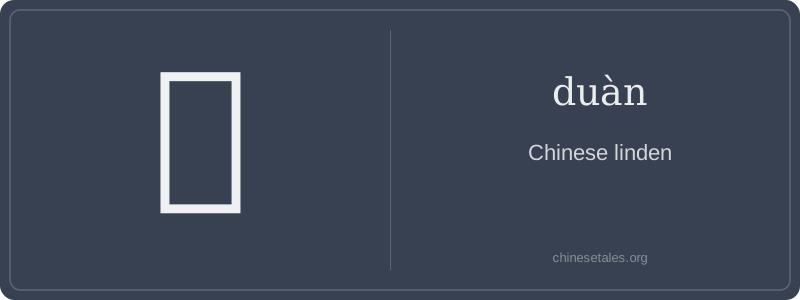
The earliest form of 椴 appears in seal script (zhuànshū), where it clearly combines the 木 (mù, 'tree') radical on the left with the phonetic component 段 (duàn) on the right. The 木 side is stable and unchanged — a classic vertical trunk with two branching strokes, instantly signaling 'wood' or 'tree'. The right side, 段, itself evolved from an earlier pictograph combining 口 (kǒu, 'mouth') and 支 (zhī, 'branch') — but by Han dynasty clerical script, it had solidified into its modern shape: a hand (又) holding a weapon-like stroke (殳), symbolizing 'cutting into segments'. Though 段 now means 'section', its role here is purely phonetic — lending the duàn sound while the 木 radical anchors the meaning.
By the Tang dynasty, 椴 was firmly established in botanical texts like the Bencao Shiyi (Supplement to the Materia Medica), where it was noted for its bark’s use in fiber-making and its flowers’ calming properties. Interestingly, the character never appears in classical poetry as a standalone image — unlike 梅 (plum) or 松 (pine) — suggesting its cultural resonance grew later, tied to practical forestry and apiculture rather than literati symbolism. Its visual design tells a quiet truth: this is a tree defined not by myth, but by utility — rooted in wood (木), sounding like division (段), yet wholly itself: a single, sweet-scented species.
Meet 椴 (duàn) — a quiet, elegant character that names a specific kind of tree: the Chinese linden (Tilia chinensis), known for its fragrant summer blossoms, soft timber, and deep roots in northern Chinese ecology. Unlike generic terms like 树 (shù, 'tree'), 椴 is precise and botanical — it’s not used metaphorically or idiomatically, and never as a verb or adjective. You’ll only encounter it in nature writing, forestry contexts, or regional descriptions — think field guides, ecological reports, or poetic references to rural landscapes. It’s a noun, period — no grammatical flexibility, no colloquial shortcuts.
Grammatically, 椴 behaves like most monosyllabic botanical nouns: it usually appears with classifiers (e.g., 一棵椴, yī kē duàn — 'one linden tree') or in compound nouns (like 椴树, duànshù). Learners sometimes mistakenly treat it as a verb ('to linden' — nonsense!) or confuse it with homophones like 段 (duàn, 'section') — but 椴 has zero abstract usage. It doesn’t mean 'segment', 'phase', or 'paragraph'; it means *only* this one beautiful, honey-producing tree. Its rarity outside specialized contexts explains why it’s absent from HSK — you won’t need it to order dumplings, but you’ll need it to identify a forest canopy in Heilongjiang.
Culturally, 椴 trees are ecological heroes: their nectar feeds bees producing prized 'linden honey', and their lightweight wood is favored for carving and musical instrument bodies (especially traditional guqin soundboards). A common learner pitfall? Assuming 椴 is interchangeable with 桐 (tóng, 'paulownia') or 榆 (yú, 'elm') — all are hardwoods, but botanically distinct and regionally associated. Also, watch your tones: saying duān (first tone) instead of duàn (fourth) might get you a puzzled look — or worse, a question about 'short sections' (段)!