楂
Character Story & Explanation
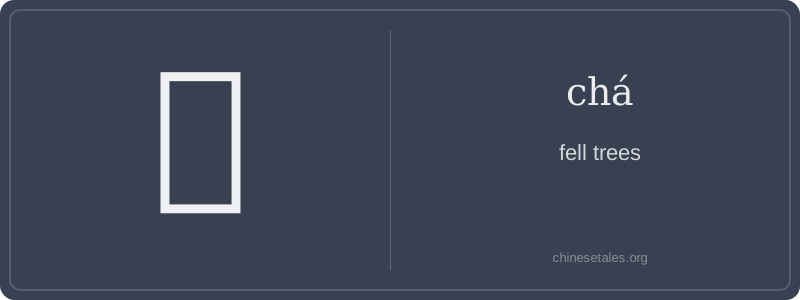
The earliest form of 楂 appears in late Warring States bronze inscriptions as a compound pictograph: a stylized tree (木) crossed diagonally by a sharp, downward-slanting stroke representing an axe blade — not a full axe, but the *instant of impact*. Over time, the ‘axe’ evolved into the right-hand component 查 (chá), which originally depicted a hand holding a tool inspecting something — here repurposed phonetically *and* semantically, since ‘inspecting’ a tree before felling implies judgment and purpose. The left 木 radical anchors its botanical domain, while the 13 strokes — including the decisive diagonal slash in 查 — echo the physical motion of the axe strike.
By the Han dynasty, 楂 appears in the *Shuōwén Jiězì* as ‘to cut down trees with an axe’, cited in agricultural edicts regulating timber use. Its meaning never broadened — unlike 刈 (yì, ‘to reap’) or 斫 (zhuó, ‘to chop’), 楂 retained its specific association with *uprooting or toppling standing trees*. In Tang poetry, it appears metaphorically: Du Fu once wrote ‘林深不楂路’ (dense woods — no path cleared by felling), subtly criticizing officials who failed to ‘clear obstacles’ for the people. Visually, the character still whispers the crunch of wood splitting — even today, if you trace the strokes slowly, your hand mimics the downward arc of the blade.
Imagine a misty mountain forest in ancient China — not the serene kind from ink paintings, but a rugged, practical place where woodsmen swing axes with rhythmic thuds. In that scene, 楂 (chá) isn’t just ‘cutting trees’ — it’s the *deliberate, forceful felling* of mature timber, often for construction or fuel. This character carries weight: it implies effort, intention, and consequence. It’s not casual pruning (修) or gentle harvesting (采); it’s decisive, irreversible action — like the sound of a trunk cracking under the axe.
Grammatically, 楂 is almost exclusively a verb, used transitively (always followed by an object), and appears mainly in classical or literary contexts — you won’t hear it in daily chat or HSK dialogues. You’ll see it in phrases like ‘楂木’ (zhāmù — a type of hardwood), but as a verb, it’s rare outside historical texts or poetic diction. Learners sometimes misread it as zhā and assume it relates to ‘hawthorn’ (山楂), but that’s a homophone trap — same sound, totally different character (楂 vs. 楂) and meaning.
Culturally, 楂 reflects pre-modern resource consciousness: felling wasn’t taken lightly — forests were communal assets, and unauthorized 楂 could carry legal penalties in Tang and Song codes. Modern learners often overgeneralize it as ‘to cut’, leading to awkward sentences like ‘我楂苹果’ (I fell an apple — nonsensical!). Remember: 楂 only takes *trees* (or tree-like things: bamboo groves, orchards), never fruit, paper, or hair.