杨
Character Story & Explanation
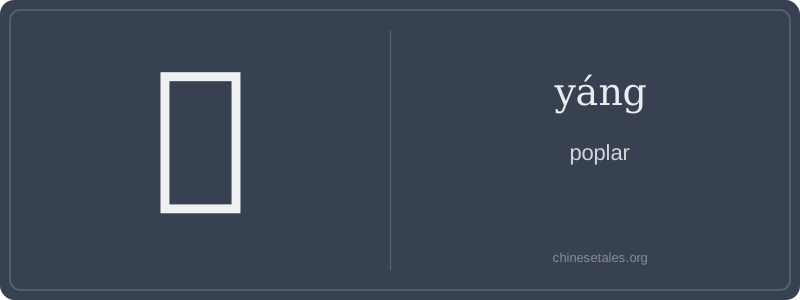
The earliest form of 杨 appears in bronze inscriptions from the Western Zhou dynasty (~1046–771 BCE), where it was written as — a tree radical (木) on the left, paired with 昜 (yáng, an ancient variant of 阳 meaning 'sunlight' or 'brightness') on the right. The 昜 component wasn’t just phonetic; it subtly reinforced the poplar’s ecological niche — these trees thrive in open, sunny places. Over centuries, 昜 simplified: its top stroke became the two dots (丶丶) above the 日-like shape, and the lower part condensed into the modern 口+勿 structure. By the Han dynasty clerical script, 杨 had stabilized into its current 7-stroke form: 木 + (a stylized, compact 昜).
This evolution wasn’t arbitrary — the visual pairing of 木 (tree) and 昜 (sunlit openness) perfectly captured how poplars behave in nature: they colonize sun-drenched riverbanks and wind-swept plains. In the Shijing (Book of Odes), poplars appear in poems about steadfastness — 'The poplar stands unbent though the gale roars' — reinforcing the link between its form (upright 木 + radiant 昜) and cultural meaning. Even today, the character feels structurally 'tall': its vertical 木 radical anchors the eye, while the right side rises diagonally — mimicking the tree’s growth pattern.
At its heart, 杨 (yáng) is a tree — specifically the fast-growing, wind-resistant poplar, with its trembling leaves and tall, straight trunk. But don’t let its botanical simplicity fool you: this character is far more than a plant name. It’s one of China’s top ten surnames (e.g., 杨利伟 Yáng Lìwěi, China’s first astronaut), and as a surname, it carries no tone shift or grammatical change — it’s always yáng, never *yǎng* or *yàng*. That’s crucial: learners sometimes misread it as the homophone 阳 (yáng, 'sun/southern side'), especially in names like 杨阳 (Yáng Yáng), where both characters are identical in sound but distinct in meaning and writing.
Grammatically, 杨 functions almost exclusively as a noun — either as the tree itself ('a poplar') or as a proper noun (a surname). You won’t find it as a verb or adjective. It rarely appears alone in speech; instead, it shows up in compounds like 白杨 (bái yáng, 'white poplar') or as part of names — making context king. If you see 杨 followed by a personal name (e.g., 杨老师), it’s almost certainly a surname, not a tree reference. Misplacing it — say, writing 杨树 (yáng shù, 'poplar tree') as *杨木* (yáng mù) — would be odd: while 木 means 'wood', 杨木 is technically correct ('poplar wood'), but native speakers prefer 杨树 for the living tree and specify 杨木材 only in lumber contexts.
Culturally, poplars symbolize resilience and upright integrity — they grow straight even in poor soil, and their wood is light yet workable. In classical poetry, 杨 often appears alongside 柳 (liǔ, willow) to evoke seasonal contrast: willows droop in spring; poplars stand firm in summer winds. A common learner trap? Confusing 杨 with 羊 (yáng, 'sheep') — same sound, totally different world. Write 杨 when you mean 'poplar' or 'Mr. Yang'; write 羊 if you’re ordering mutton.