楘
Character Story & Explanation
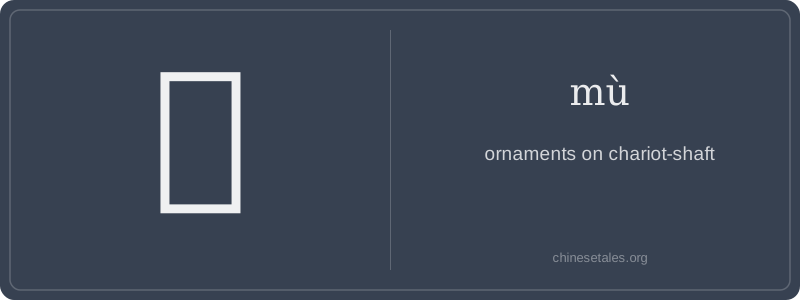
The earliest form of 楘 appears in late Western Zhou bronze inscriptions as a complex pictograph: a horizontal shaft (—) topped by a stylized double-ring motif (often drawn as two stacked circles or concentric ovals), flanked by vertical strokes suggesting mounting brackets — all enclosed within the 木 (wood) radical to indicate its material base. Over centuries, the rings simplified into the top component 木 + 目-like shape (though not 目!), and the bracket strokes merged into the lower right-hand ‘foot’ (灬-like but actually a variant of 火 or 灬-derivative — though scholars debate whether this evolved from fire symbolism or a stylized metal inlay mark). By the Han clerical script, it stabilized into today’s form: 木 on the left, and a compact, dense right-hand component resembling 目 but with four short horizontal strokes inside — not eyes, but engraved bands on bronze.
This character’s semantic journey is tightly bound to the rise and fall of the chariot state. In the Book of Rites (《禮記》), 楘 appears in passages describing ceremonial processions where ‘the sound of the 楘 rings marked the Duke’s arrival’ — implying acoustic function too. As chariots faded after the Warring States period, so did 楘: no Tang poets used it, no Song encyclopedias defined it independently. Its survival is purely philological — preserved only because scholars like Zheng Xuan (127–200 CE) annotated it in commentaries on lost ritual texts. Visually, those four inner strokes aren’t arbitrary: they echo the four cardinal directions, reinforcing the idea that the chariot shaft — adorned with 楘 — was a microcosm of heaven and earth.
Meet 楘 — a character so rare it’s vanished from modern textbooks, dictionaries, and even most native speakers’ active vocabulary. Pronounced mù, it doesn’t mean ‘wood’ or ‘tree’ (like the common mù in 木), nor does it refer to any everyday object. Its core meaning is hyper-specific: the ornamental metal fittings — often bronze rings, knobs, or carved jade plaques — that decorated the *front end of a chariot’s central shaft* in ancient China’s elite war chariots. This isn’t decorative fluff; these ornaments signaled rank, ritual purity, and martial prestige. You’ll never see 楘 in spoken Mandarin today — it’s strictly classical, appearing only in bronze inscriptions, excavated bamboo texts, and commentary on Zhou dynasty rites.
Grammatically, 楘 functions exclusively as a noun — always embedded in compound terms like 楘飾 (mù shì, ‘shaft ornaments’) or 楘環 (mù huán, ‘shaft ring’). It never stands alone in sentences, never takes aspect particles (了, 過), and never appears in verbs or adjectives. Learners sometimes misread it as 木 (mù, ‘wood’) due to the shared wood radical and pronunciation — but while 木 is foundational, 楘 is fossilized elegance: a linguistic artifact you’d find only in an archaeologist’s notebook, not a café menu.
Culturally, 楘 reveals how deeply material detail mattered in early Chinese cosmology: every part of the ritual chariot mirrored celestial order. Confusing it with similar-looking characters (like 暮 or 幕) isn’t just a spelling error — it erases a precise layer of Bronze Age semiotics. The real trap? Assuming all mù-sounding wood-radical characters are interchangeable. They’re not — this one is a gilded bolt on a royal chariot, not a log in a forest.