楛
Character Story & Explanation
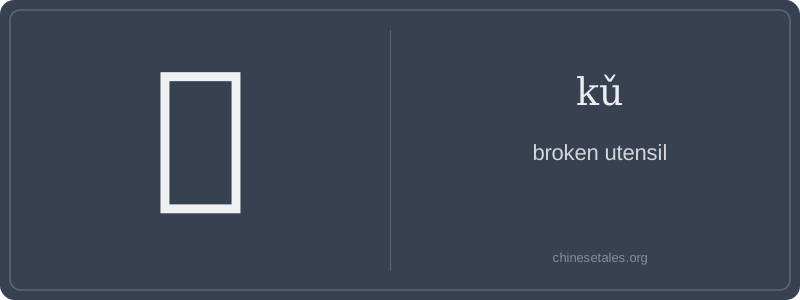
The earliest form of 楛 appears in Warring States bamboo slips — not as a pictograph, but as a semantic-phonetic compound: 木 (wood) on the left, clearly signaling its domain, and 古 (gǔ, ‘ancient’) on the right, serving both sound and subtle meaning. 古 isn’t just phonetic; it evokes antiquity, time-worn fragility — wood so old or ill-chosen that it crumbles *before* use. Over centuries, the 古 component tightened: its upper ‘ten’ (十) and lower ‘mouth’ (口) compressed, strokes smoothed, and the final dot stabilized into today’s 13-stroke structure — still unmistakably ‘wood + ancient’ at its core.
This etymology shaped its meaning precisely: 楛 never meant ‘broken by accident’ (that’s 碎 or 折), but ‘broken by nature’ — wood too dry, warped, or knotty to withstand stress. The *Zuo Zhuan* (c. 4th c. BCE) uses 楛 to describe ritual vessels rejected for sacrifice due to flawed grain — a flaw invisible until force was applied. Its visual duality — sturdy 木 radical paired with aging 古 — mirrors this tension: outwardly whole, inwardly compromised. Even today, conservators in Beijing’s Forbidden City use 楛 to document timber that *looks* sound but fails structural testing.
Imagine you’re rummaging through an old scholar’s attic in Suzhou — dust motes dancing in slanted light, bamboo shelves sagging under centuries-old texts. You lift a lacquered wooden spoon… and it snaps cleanly in half with a soft *crack*. Not from rot or age, but from brittle, flawed grain — the wood was *kǔ*: structurally unsound, doomed to break. That’s 楛: not just ‘broken’, but *inherently defective* — a utensil that fails because its material was never fit for purpose. It’s poetic, almost philosophical: failure baked into the making.
Grammatically, 楛 is almost exclusively literary or classical. You won’t hear it in daily speech — no one says ‘my chopsticks are kǔ!’ Instead, it appears in set phrases like 楛窳 (kǔ yǔ), meaning ‘shoddy, poorly made’, or as a standalone adjective in formal writing describing flawed craftsmanship or hollow institutions. Learners often misread it as kū (like 哭) or confuse it with 苦 (kǔ, ‘bitter’) — but while 苦 describes taste or hardship, 楛 points to *material inadequacy*, a silent judgment on integrity itself.
Culturally, 楛 carries quiet moral weight. In ancient texts, calling something 楛 wasn’t just descriptive — it implied negligence, haste, or disrespect for craft. Confucian artisans were expected to honor materials; 楛 was the antithesis. Modern learners rarely encounter it outside classical poetry or heritage conservation reports — making it a linguistic ‘antique’ that still speaks volumes about Chinese values of substance over surface.