楟
Character Story & Explanation
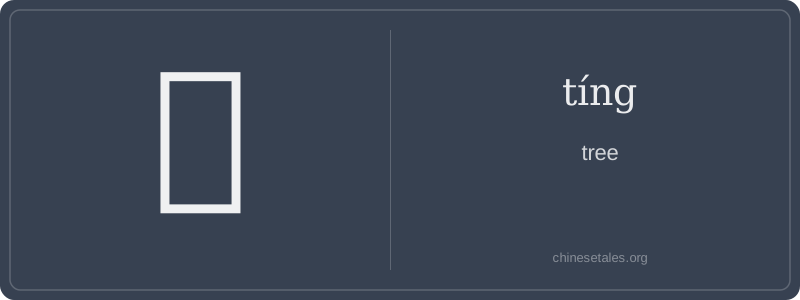
The earliest form of 楟 appears not in oracle bones — but in later seal script, where it’s a clear compound: 木 (wood/tree) on the left, and 亭 (tíng, ‘pavilion’) on the right. The 亭 component itself evolved from a pictograph of a roofed structure with pillars — imagine four posts holding up a tiled eave. When fused with 木, the image becomes unmistakable: a tree so upright and symmetrical it resembles a freestanding pavilion — slender trunk, balanced canopy, architectural poise. Over centuries, clerical and regular script simplified the strokes: the roof of 亭 softened into the dot-and-hook shape (亠 + 冖), while the pillar strokes condensed, but the elegant duality — nature as architecture — remained intact.
This visual logic shaped its meaning. In texts like the *Erya* (c. 3rd century BCE), 楟 was defined as ‘a tree whose branches spread evenly, like a pavilion’s eaves’. It appeared in Tang dynasty poems describing imperial gardens, where such trees marked ceremonial pathways. Unlike 柏 (cypress) or 松 (pine), which carried Daoist or longevity symbolism, 楟 embodied Confucian ideals: upright conduct, measured growth, harmony between human design and natural form. Its rarity today isn’t neglect — it’s preservation: a linguistic bonsai, kept alive only where grace and restraint matter most.
Here’s the truth no textbook tells you: 楟 (tíng) isn’t just ‘tree’ — it’s a ghost word. In modern Standard Mandarin, it’s virtually extinct in speech and writing. You won’t hear it in daily conversation, see it on street signs, or find it in HSK textbooks. Its core meaning *is* ‘tree’, yes — but not the generic kind. Historically, it referred specifically to a tall, straight, stately tree — often one planted in formal settings like ancestral courtyards or temple grounds, evoking dignity, endurance, and rootedness in tradition. That quiet gravitas still echoes in its structure: the wood radical (木) anchors it, while the top part (亭) hints at a pavilion — suggesting trees that stand like architectural pillars in human space.
Grammatically, 楟 behaves like a classical noun: it appears almost exclusively in literary compounds, poetic lines, or fixed phrases — never as a standalone subject or object in modern sentences. Learners sometimes try to use it like 树 (shù), saying *‘wǒ kàn dào yī kē tíng’* — but that’s instantly jarring to native ears. Instead, it only surfaces where elegance and antiquity are intentional: in names of rare tree species (e.g., 楟香, tíngxiāng), classical poetry, or calligraphic inscriptions. It’s not wrong — it’s *archaic*, like using ‘thou’ in an email.
Culturally, 楟 reveals how Chinese values embed meaning in botanical precision: not all trees are equal — some carry ritual weight. Mistaking it for common terms like 树 or 林 is a subtle but telling error: it confuses the sacred grove with the forest. Also, watch out for tone — tíng (second tone) is easily mispronounced as tǐng (third tone, ‘to stiffen’) or tīng (first tone, ‘to listen’). That tiny pitch shift can turn ‘stately tree’ into ‘stiffen up’ — an awkward botanical metamorphosis.