楣
Character Story & Explanation
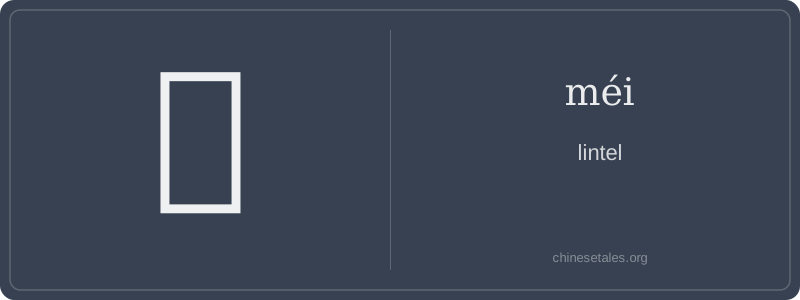
The earliest form of 楣 appears in bronze inscriptions (jinwen) as a pictograph showing two upright posts (like 木 on either side) with a thick horizontal stroke bridging them — unmistakably a beam over an entrance. Over time, the dual posts simplified into the left-side 木 (wood) radical, while the right side evolved from 眉 (méi, eyebrow) — not by accident, but by analogy: just as eyebrows frame the eyes, the lintel frames the doorway. The modern character retains that elegant duality: 木 signals material (traditionally wood), and 眉 hints at its framing, ‘brow-like’ position.
This visual pun deepened in meaning during the Han dynasty, when texts like the Shuōwén Jiězì defined 楣 as ‘the horizontal timber above the door — like the brow above the eye.’ Poets seized the metaphor: Du Fu wrote of ‘broken lintels and fallen beams’ (楣栋摧折) to evoke dynastic collapse — where the 楣 wasn’t just timber, but the dignity of order itself. Even today, restoring a historic temple’s 楣 means more than carpentry: it’s reattaching the symbolic ‘brow’ of cultural continuity.
At its core, 楣 (méi) isn’t just a technical term for ‘lintel’ — it’s a quiet witness to Chinese architectural philosophy: strength hidden in harmony. Unlike Western lintels that often shout structural dominance (think stone arches or steel beams), the 楣 is traditionally a horizontal wooden beam resting *gracefully* across two vertical posts, bearing weight without drawing attention — embodying the classical ideal of ‘wu wei’ (effortless action). You’ll almost never see 楣 used alone; it appears only in compound nouns like 门楣 (mén méi, door lintel) or 檐楣 (yán méi, eave lintel), always paired with another character specifying location or function.
Grammatically, 楣 is a noun-only character — no verbs, no adjectives, no colloquial shortening. It doesn’t appear in spoken Mandarin outside formal or descriptive contexts (e.g., architecture, heritage restoration, or classical poetry). Learners sometimes mistakenly use it like a generic ‘beam’ — but 梁 (liáng) is the broader term for load-bearing beams, while 楣 is strictly *the horizontal element above an opening*. Also, don’t confuse it with 眉 (méi, eyebrow) — same pronunciation, totally different world: one sits above your eyes, the other above your doorway, both ‘brows’ of their respective domains.
Culturally, the 门楣 (mén méi) carries symbolic weight: in imperial China, families displayed rank and achievement on their door lintels — plaques honoring scholars or officials were mounted *on* the 楣, making it a literal ‘face’ of the household. Today, when you hear someone say ‘low door lintel’ (门楣太低), it’s often a metaphor for humble origins — not just architecture, but social identity. That’s why this unassuming 13-stroke character opens a door into values far deeper than carpentry.