楪
Character Story & Explanation
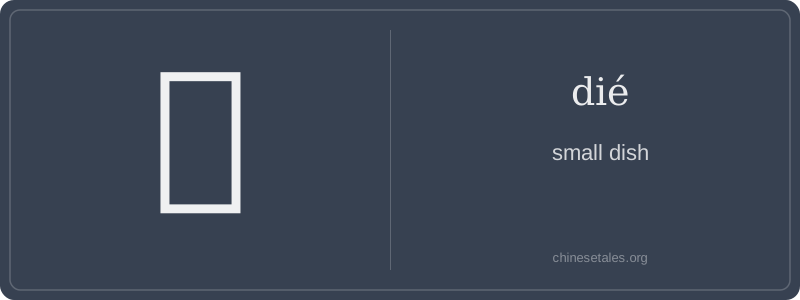
The earliest form of 楪 appears in late Warring States bamboo texts as a compound pictograph: the left side (木) clearly depicts a tree or wooden object, while the right side (枼) originally showed stacked leaves (葉) — but here, stylized as layered, overlapping plates. Over time, the ‘leaves’ simplified into three horizontal strokes under a ‘lid-like’ top (世), evolving through Han clerical script into the modern 枼 component — still suggesting thin, stacked, shallow layers, like nested dishes.
This visual logic anchored its meaning: a shallow wooden or lacquered vessel, distinct from deep bowls (碗) or wide platters (盘). In the Tang dynasty *Yunlin Shilu* (Records of Cloud-forest Poetry), 楪 appears in a line describing a scholar’s study table: ‘one inkstone, one brush, one 楪 of dried osmanthus’ — highlighting its role in scholarly refinement. Its wood radical (木) wasn’t arbitrary: most authentic 楪 were carved from pearwood or catalpa, prized for their fine grain and resonance — making the character itself a silent tribute to craftsmanship and material memory.
Imagine you're at a quiet, centuries-old teahouse in Hangzhou, where the master pours jasmine tea into delicate porcelain vessels — not cups, not bowls, but something in between: shallow, rimmed, slightly flared, just big enough for one sip or a single preserved plum. That vessel? That’s a dié (楪). It’s not flashy or functional like a bowl (bō) or cup (bēi); it’s ceremonial, intimate, almost poetic — a ‘small dish’ that holds intention more than volume.
Grammatically, 楪 is a noun used almost exclusively in literary, historical, or artisanal contexts — never in daily speech or HSK materials. You’ll find it in classical poetry describing banquet settings (‘a lacquered 楪 holding candied ginger’) or in museum labels for Song-dynasty ceramics. Crucially, it’s *not* a measure word (like ‘ge’ or ‘zhi’) and never pluralized — it’s always singular, concrete, and evocative. Learners sometimes misread it as ‘dié’ meaning ‘to fold’ (叠), or confuse it with ‘yè’ (叶, leaf), leading to absurd translations like ‘folded leaf dish’.
Culturally, 楪 embodies the Chinese aesthetic of *xiǎo ér jīng* — ‘small yet refined’. Its rarity today makes it a linguistic heirloom: when you see it, you’re not just reading a word — you’re glimpsing a vanished dining ritual where even the dish was a brushstroke in a larger composition of harmony and restraint.