楷
Character Story & Explanation
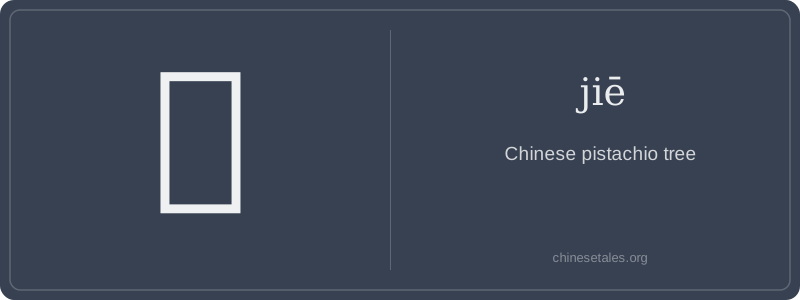
The earliest form of 楷 appears in seal script (around 200 BCE), where it clearly shows its radical 木 (‘tree’) on the left — a stylized trunk with branching roots and canopy — and the right side, 賈 (gǔ), which originally depicted a merchant with goods at a market stall. Over centuries, 賈 simplified into its modern component: ten strokes forming a compact, angular shape that retained phonetic function (gǔ → jiē via sound shifts in Middle Chinese). By the Song dynasty, the character stabilized into today’s 13-stroke form: 木 + 賈’s streamlined descendant, now visually balanced but still unmistakably woody.
This character’s evolution reveals a beautiful linguistic layering: 賈 was chosen not for meaning, but for sound — a common practice in phono-semantic compounds. Yet the semantic link deepened over time: just as merchants traveled widely and adapted, the 楷 tree thrives in varied soils and climates. Classical texts like the *Qimin Yaoshu* (6th c. CE agricultural manual) note its use for timber and dye, while Ming-era herbals praise its bark for tannin extraction. Its visual ‘uprightness’ — tall trunk, symmetrical crown — later fed into the moral metaphor behind kǎi (‘model’, ‘exemplar’), making 楷 a rare character that grew two distinct, parallel meanings from one root — botany and virtue — split only by tone.
At first glance, 楷 (jiē) feels like a quiet, rooted word — it’s the Chinese pistachio tree (Pistacia chinensis), a hardy, drought-tolerant native species often planted along city streets in southern China. Unlike flashy ornamentals, this tree embodies understated resilience: its wood is dense and fine-grained, its leaves turn vivid crimson in autumn, and its small red drupes feed birds but aren’t harvested for humans. To Chinese speakers, 楷 carries botanical precision — it’s not a generic ‘tree’ but a specific, ecologically grounded name, reflecting how deeply Chinese naming ties flora to local ecology and utility.
Grammatically, 楷 functions almost exclusively as a noun — you’ll see it in botanical contexts, urban planning documents, or ecological reports. It rarely appears in everyday speech or beginner materials (hence its absence from HSK), and never as a verb or modifier. Learners sometimes misread it as kǎi (like in 楷书 ‘regular script’) and insert it into calligraphy discussions — a classic mix-up! Remember: jiē = tree, kǎi = script — same character, different pronunciation, entirely separate semantic worlds. No overlap in usage.
Culturally, 楷 trees are quietly symbolic: they’re favored in memorial parks and university campuses for their longevity and dignity, subtly echoing the Confucian ideal of ‘upright virtue’ (which also resonates with the kǎi pronunciation’s association with moral models). But crucially — this meaning lives *only* in the kǎi reading. When pronounced jiē, it’s purely botanical. Learners’ biggest trap? Assuming homographs share meaning — here, they don’t. Pronunciation isn’t optional; it’s the semantic gatekeeper.