榔
Character Story & Explanation
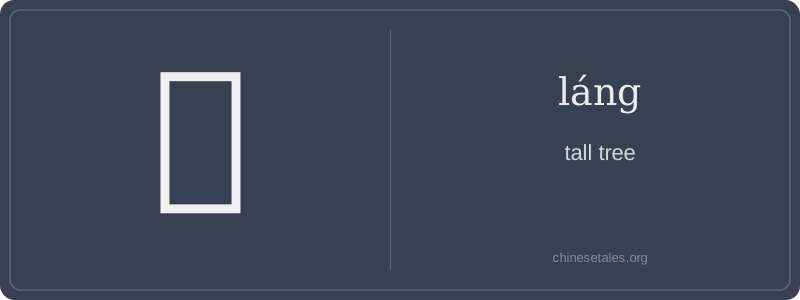
The earliest form of 榔 appears in seal script (around 220 BCE), evolving from a combination of 木 (tree) on the left and 良 (liáng, 'good, fine') on the right — not as a semantic-phonetic pair in the usual sense, but as a deliberate fusion: 'wood so fine it stands tall and strong.' Visually, the 木 radical anchors it in the arboreal world, while 良’s original oracle bone shape depicted a mouth above a shelf — later stylized into its current six-stroke form — symbolizing something elevated, well-proportioned, and worthy of notice. Over centuries, the right-hand component simplified from complex bronze-era forms into today’s clean, balanced 良, preserving both phonetic resonance (láng and liáng share the same ancient rime group) and conceptual weight.
This character first appeared in classical texts like the *Nanfang Caomu Zhuang* (Records of Southern Plants and Trees, 3rd c. CE), where it described the betel palm — not for its timber, but for its striking verticality and economic importance. Poets like Li Bai later used 榔 metaphorically: 'bamboo and láng sway in unison' implied harmony between flexible grace (bamboo) and unwavering height (láng). The character’s enduring power lies in this duality — it looks like 'wood + excellence', and indeed, it names trees that excel at rising above the rest.
Think of 榔 (láng) as the Chinese equivalent of 'redwood' or 'sequoia' — not just any tree, but a towering, stately one that commands attention and respect. Its core meaning isn’t generic 'tree' (that’s 木 alone), but specifically a tall, hardwood tree — historically associated with durability, height, and quiet grandeur. You’ll rarely see it solo; it almost always appears in compound words like 椰榔 (yē láng) or 槟榔 (bīn láng), where it contributes the 'tall, sturdy, woody' nuance — like adding 'oak' to 'oak-aged whiskey' to imply strength and tradition.
Grammatically, 榔 is never used independently as a noun in modern speech — no one says 'Look at that láng!' It functions exclusively within fixed compounds, mostly botanical or medicinal terms. Learners sometimes mistakenly treat it like a free-standing word (e.g., trying to say *láng shù* for 'tall tree'), but that’s ungrammatical — the correct phrase is 高树 (gāo shù). Also, be careful: while 榔 sounds like 'lang' (as in 'language'), it has zero relation to speech or sound — a classic false friend trap!
Culturally, 榔 carries subtle prestige: its presence in names like 槟榔 (betel nut palm) evokes tropical resilience and ritual significance across southern China and Southeast Asia. But here’s the kicker — though it means 'tall tree', it’s most famous for describing a *palm*, which botanically isn’t a 'tree' at all (palms are monocots, not woody dicots). This lexical mismatch reveals how Chinese categorization prioritizes visual impression (height + trunk + canopy) over botanical taxonomy — much like calling a whale a 'fish' in pre-scientific English.