榤
Character Story & Explanation
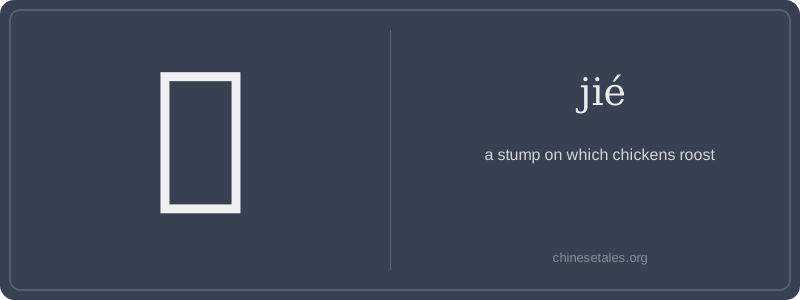
The earliest trace of 榤 isn’t in oracle bones — it’s absent from Shang and Zhou inscriptions entirely. It first appears in late Ming dynasty agricultural glossaries as a regional folk character, likely coined by farmers who needed a precise term for the specific type of short, sturdy, forked wooden stump placed inside coops. Visually, it’s a clear compound: the left side is 木 (mù, ‘tree/wood’), anchoring it in the material world; the right side is 吉 (jí, ‘auspicious’), borrowed here purely for sound (jié), though folk etymology later imagined ‘auspicious perch’ — as if chickens choosing it brought good luck to the flock.
By the Qing dynasty, 榤 appears in local gazetteers describing ‘chicken-keeping customs’, where it’s noted that ideal 榤 were made from locust wood — hard, splinter-resistant, and naturally insect-repellent. The character never entered formal lexicons like the Kangxi Dictionary, remaining stubbornly vernacular. Its shape stayed stable: no stroke evolution occurred because it was rarely printed or calligraphed — it lived in speech, not ink. Even today, when elderly farmers sketch it in dust, they draw 木 + 吉 without hesitation, as if the sound-meaning bond were carved deeper than any bamboo slip.
Let’s get real: 榤 (jié) is a linguistic fossil — a hyper-specific, almost extinct word for 'chicken roosting stump', like the wooden perch chickens hop onto at dusk. It’s not poetic or abstract; it’s barn-yard concrete. You won’t hear it in modern Mandarin conversation, nor find it in textbooks — it survives only in regional dialects (especially Shandong and Henan rural speech), classical agricultural manuals, and occasionally in literary descriptions of rustic life. Its core feel is tactile and grounded: rough wood, claw marks, dawn light on a weathered log.
Grammatically, 榤 functions strictly as a noun — never a verb or adjective — and almost always appears with classifiers like 根 (gēn, for long cylindrical objects) or 个 (gè, generic). You’d say ‘一根榤’ (yī gēn jié), not ‘榤了’ or ‘很榤’. Learners sometimes wrongly treat it like a verb (e.g., *‘鸡榤在树上’*), but that’s ungrammatical — chickens *roost*, but the stump itself *is* the 榤. Also, it’s never used metaphorically — unlike ‘perch’ in English, you won’t see ‘political 榤’ or ‘career 榤’.
Culturally, this character embodies pre-industrial Chinese agrarian precision: every farm object had its own name, down to the exact kind of stump used for poultry. That specificity has faded — today, most speakers just say ‘鸡架’ (jī jià, chicken rack) or ‘鸡栖木’ (jī qī mù, roosting wood). A common mistake? Confusing 榤 with 截 (jié, ‘to cut off’) due to identical pronunciation and shared ‘木’ radical — but while 截 implies action and separation, 榤 is pure stillness: an object waiting patiently for feathers.