榦
Character Story & Explanation
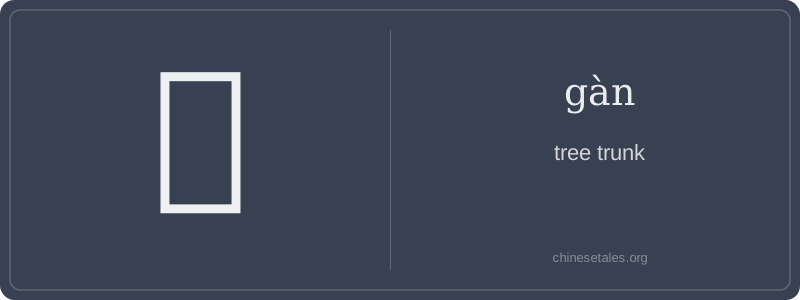
The earliest form of 榦 appears in bronze inscriptions as a stylized tree: two parallel vertical lines (representing the trunk), flanked by short horizontal strokes (branches), and anchored by a base — sometimes with a root-like flourish. Over centuries, the branch strokes simplified and merged, while the left side evolved into the 木 (mù, 'tree') radical, making the meaning unmistakable. The right side solidified into 旱 (hàn, 'drought'), not for its meaning, but as a phonetic component — a common pattern where sound guides form. By the seal script era, the structure was stable: 木 + 旱 = a tree’s enduring core.
In classical texts, 榦 appears in works like the *Book of Rites* (礼记) to symbolize foundational strength — ‘the trunk governs the branches’ became a metaphor for hierarchy and moral centrality. Later, poets like Du Fu used 榦 to evoke age and endurance: an ancient pine’s 榦, gnarled and unbroken, mirrors the sage’s unwavering virtue. Visually, the character’s tall, narrow shape mimics a trunk itself — upright, grounded, and unadorned — reinforcing how Chinese writing marries form and meaning at the deepest level.
Think of 榦 (gàn) as the 'backbone' of a tree — not just wood, but structural integrity, vertical strength, and quiet centrality. It’s a poetic, literary word for 'trunk', rarely used in daily speech (you’ll say 树干 shùgàn instead), but deeply evocative in classical and modern written Chinese. Unlike the neutral 树干, 榦 carries weight: it implies resilience, uprightness, and organic unity — like the unbroken core that supports all branches and leaves.
Grammatically, 榦 almost never stands alone; it appears only in compounds or classical phrases, often paired with other nature-related characters (e.g., 枝榦 zhīgàn 'branches and trunk'). You won’t say *‘This tree has a big 榦’* — that sounds archaic or poetic. Instead, you’ll encounter it in fixed expressions like ‘主榦’ (zhǔgàn, ‘main trunk’) or in botanical or literary descriptions where precision and elegance matter more than colloquial fluency.
Culturally, 榦 subtly echoes Confucian ideals: the trunk is upright, central, unyielding — much like the junzi 君子 (noble person). Learners often misread it as 干 (gān/gàn, ‘dry’/‘to do’), especially since they share pronunciation and appear similar in handwriting. But here’s the trap: 干 has no wood radical — it’s a completely different character! Confusing them turns a botany passage into nonsense. Also, note: 榦 is *not* used for ‘trunk’ in compound words like ‘airplane trunk’ — that’s 舱 (cāng). This one stays firmly rooted in trees and metaphor.