榫
Character Story & Explanation
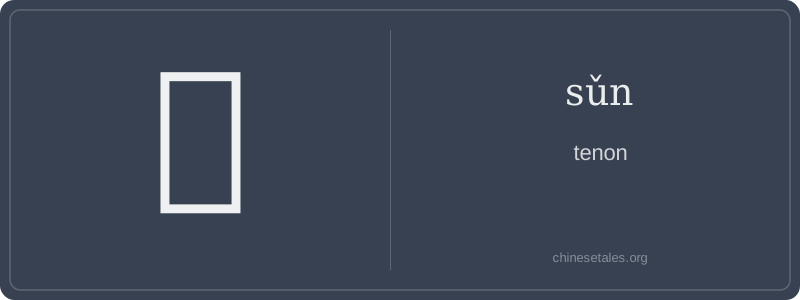
The earliest form of 榫 appears not in oracle bones but in Warring States bamboo slips, where it was written as 木 + 允 — the ‘wood’ radical anchoring a phonetic component that resembled a bent arm holding something precise. Over centuries, 允 evolved into 全 (quán, ‘complete’), likely because a well-fitted tenon makes a joint ‘complete’ — seamless and whole. By the Han dynasty, the character stabilized as 木 + 全, with the four dots at the bottom (灬) replaced by the modern 一 and 丨 strokes — mirroring how carpenters shave and square the tenon’s end for perfect insertion.
This visual evolution mirrors its semantic journey: from a concrete carpentry term in the Kaogong Ji (‘Record of Trades’, c. 3rd century BCE) — which details ideal tenon width-to-depth ratios — to a subtle cultural metaphor in Ming-Qing literati writings, where ‘sǔn mǎo compatibility’ implied moral alignment between ruler and minister. Even today, architects describe traditional timber framing not as ‘joined’, but as ‘interlocked via sǔn mǎo’ — honoring the idea that strength lies in mutual fit, not force.
Imagine you’re in a Beijing hutong, watching an elderly carpenter restore a Qing-dynasty gate. With no nails or glue, he taps two wooden beams together — *click-clack* — and they lock perfectly. That protruding, tongue-like wooden peg? That’s the sǔn (榫), the tenon. In Chinese, 榫 isn’t just a technical term — it evokes craftsmanship, harmony, and silent precision. It’s never used alone in speech; you’ll only see it paired: sǔn mǎo (榫卯), the entire mortise-and-tenon joint system — a phrase that sounds like ‘sun-mow’ and rolls off the tongue with satisfying symmetry.
Grammatically, 榫 is a noun-only character, almost always bound in compounds. You won’t say ‘this beam has a sǔn’ — you’ll say ‘the sǔn mǎo structure holds the roof’. Learners sometimes misread it as ‘shǔn’ (like ‘suck’) due to tone confusion, but the third tone (sǔn) is firm and downward — like tapping a tenon into place. Also, avoid using it metaphorically without context: while English says ‘a perfect fit’, Chinese speakers rarely say ‘our ideas have a sǔn mǎo connection’ — that’s poetic license, not natural usage.
Culturally, 榫 is a quiet icon of pre-industrial Chinese ingenuity. Its absence from HSK reflects how specialized vocabulary slips through standardized lists — yet it appears in UNESCO documents about Forbidden City restoration and even in modern architecture lectures. A common mistake? Confusing it with 损 (sǔn, ‘to damage’) — same sound, opposite meaning! One builds; the other breaks. Remember: wood (木) + ‘sun’-like shape = structural strength, not loss.