榷
Character Story & Explanation
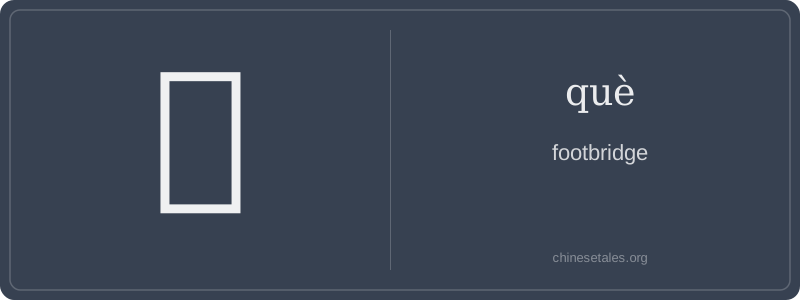
The earliest form of 榷 appears in Han dynasty clerical script (lìshū), not oracle bone — because it wasn’t pictographic at all. It’s a phono-semantic compound: the left side 木 (mù, 'tree/wood') signals material, while the right side 雀 (què, 'sparrow') provides the sound. But here’s the twist: 雀 wasn’t chosen for birds — it was selected purely for its pronunciation *què*, and its shape happened to be compact and balanced. Over time, the 雀 component simplified from a full sparrow pictograph (with head, wings, and tail) into today’s streamlined 4-stroke form, while the 木 retained its classic three-horizontal-line structure — giving us the clean, symmetrical 14-stroke character we see now.
This character first appeared in texts like the Book of Song (《宋书》) describing regulated trade zones, where 'footbridges' weren’t just physical crossings but symbolic thresholds — guarded, taxed, and administratively defined. The visual balance of 木 + 雀 subtly mirrors that duality: wood grounds it in reality; the sparrow’s lightness hints at oversight, mobility, and regulation. By Tang and Song dynasties, 榷 had shifted from describing infrastructure to naming institutions — like 榷货 (regulated goods) — proving how a concrete image of timber over water evolved into an abstract concept of controlled exchange.
Think of 榷 (què) not as a generic 'bridge' like 桥 (qiáo), but as the ancient Chinese equivalent of a drawbridge — specifically, a wooden footbridge built across moats or narrow streams near fortified gates. Its core meaning isn’t just 'footbridge', but 'a controlled, elevated crossing that regulates movement' — hence its rare but precise usage in classical and literary contexts where access, passage, or oversight is implied. You’ll almost never hear it in daily speech; it lives in poetry, historical texts, and formal compound words.
Grammatically, 榷 functions only as a noun — never a verb or adjective — and appears almost exclusively in fixed compounds (e.g., 榷场, 榷税). It doesn’t stand alone in sentences like 桥 does. A beginner might wrongly insert it into 'I crossed the bridge' — but that’s 桥 or even 过道; 榷 would sound archaic and jarringly specific, like saying 'I traversed the portcullis-lifted timber span' instead of 'I crossed the bridge'. It’s a lexical antique: precise, evocative, and reserved for contexts where architecture meets authority.
Culturally, 榷 carries echoes of frontier control — think Song dynasty border markets (榷场) where trade was taxed and monitored. Learners often misread its pronunciation (què, not quē or qiǎo) or confuse it with 樂 (lè/yuè) due to visual similarity in handwriting. Its radical 木 (wood) is literal: these bridges were timber-built, engineered for function over form, and deliberately temporary or adjustable — a nuance lost if you treat it like any other 'bridge' character.