榼
Character Story & Explanation
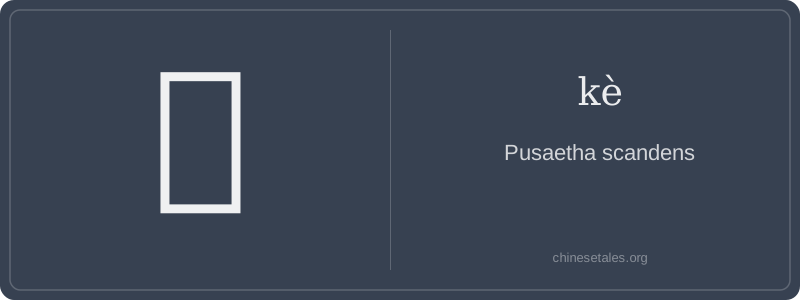
The earliest form of 榼 doesn’t appear in oracle bones—but in bronze inscriptions and early seal script, where it emerged as a phono-semantic compound: the left side 木 (mù, 'tree') anchors its botanical nature, while the right side 與 (yǔ, archaic variant of 与) served phonetically—later simplifying into 亥 (hài) in clerical script, then stabilizing as the modern right component. Visually, it’s a tree reaching upward, its branches entwining—a subtle echo of Pusaetha’s climbing habit. Stroke by stroke, the 木 radical (4 strokes) grounds it; the right side evolved from 与’s complex strokes to the compact 亥 (6 strokes), yielding today’s 10-stroke structure.
This character first bloomed in the Shennong Bencao Jing (Divine Farmer’s Materia Medica, c. 200 CE), where 榼藤 was noted for its hard, bean-like seeds used to treat rheumatism. By the Song dynasty, scholars like Su Song documented its habitat in southern forests—and crucially, began distinguishing 榼 from similar-sounding terms like 槲 (hú, oak) or 柯 (kē, branch). Its visual form—wood + a rising, curving right side—mirrors the vine’s growth: rooted yet ascending, humble yet tenacious.
Imagine you’re wandering through a misty mountain forest in Sichuan, and an elderly herbalist points to a twisting vine with heart-shaped leaves and tiny yellow flowers—'That’s kè,' she says, tapping her bamboo basket. 'Pusaetha scandens—the vine that climbs like memory.' In Chinese botanical texts, 榼 (kè) isn’t a common word you’ll hear in daily chat—it’s a precise, scholarly term used almost exclusively in classical herbals, modern pharmacopeias, and ecological field guides. It carries the quiet authority of scientific nomenclature: never pluralized, never conjugated, always standing alone as a noun.
Grammatically, 榼 behaves like a monosyllabic botanical noun—it appears after measure words (e.g., 一株榼), in compound terms (like 榼藤子), or as the subject/object in formal descriptions ('榼喜阴湿,根可入药'). You’ll almost never see it in casual speech or beginner dialogues; confusing it with more common words like 可 (kě) or 刻 (kè) is a classic trap—especially since its pronunciation matches the latter, but its meaning has zero overlap with 'carve' or 'moment.'
Culturally, 榼 reflects how Classical Chinese encoded precise natural knowledge into single characters—long before Linnaean taxonomy. Modern learners often misread it as a typo for 刻 or even 壳 (shell), missing its delicate ecological specificity. Its rarity means it’s not about frequency—it’s about fidelity: one character, one plant, one lineage of medicinal wisdom passed from Tang dynasty herbals to today’s TCM research papers.