槁
Character Story & Explanation
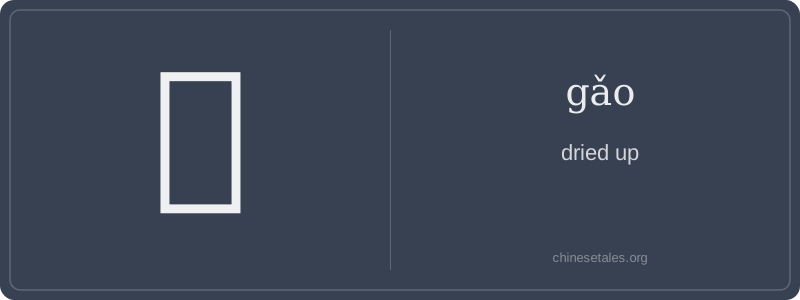
The earliest form of 槁 appears in bronze inscriptions as a tree (木) with three jagged, broken-off branches above — not leaves, but fractured, lifeless stubs. Over centuries, the top evolved into the component 高 (gāo, ‘tall’), but crucially, this wasn’t about height: the ‘high’ part stylized the brittle, upright dryness of dead wood, while the 木 radical rooted it firmly in the plant world. By the Small Seal Script, the character had stabilized into today’s 14-stroke structure — a visual paradox: ‘tall’ + ‘tree’ = ‘utterly desiccated’, capturing how drought lifts sap, leaving only stiff, hollow stalks standing.
This semantic shift deepened in classical literature: Zhuangzi used 槁木 (gǎo mù, ‘withered wood’) to describe meditative stillness — not death, but a state beyond desire, like a tree emptied of seasonal pulse. Later, in Tang poetry and Song medical classics, 槁 expanded metaphorically to human conditions: 槁容 (gǎo róng, ‘withered countenance’) described illness-induced pallor, and 槁心 (gǎo xīn) meant ‘a heart drained of warmth’. The character never lost its botanical anchor — even in abstract usage, you can still see the cracked bark and leafless boughs in every stroke.
At its core, 槁 (gǎo) isn’t just ‘dried up’ — it’s the visceral, almost mournful image of life drained away: brittle twigs, withered grass, a face gaunt from grief or exhaustion. Unlike generic words like 干 (gān, ‘dry’), 槁 carries poetic weight and literary gravity; it evokes decay that’s irreversible, not just temporary dehydration. You’ll rarely hear it in daily chat — no one says ‘my coffee is 槁’ — but in classical poetry, medical texts, or solemn essays, it delivers emotional precision: think ‘a 槁木 heart’ meaning emotionally desiccated, not merely ‘unfeeling’.
Grammatically, 槁 functions almost exclusively as an adjective before nouns (e.g., 槁木, 槁容), or in fixed compound forms. It doesn’t take aspect particles like 了 or 过, nor does it reduplicate — trying to say *槁槁* or *槁了* will sound jarringly unnatural to native ears. It also resists modern colloquial modifiers: you won’t find ‘very 槁’ (很槁) — instead, intensifiers like 枯槁 (kū gǎo) or 形容枯槁 (xíng róng kū gǎo) do the heavy lifting.
Culturally, 槁 reveals how Chinese aesthetics and medicine intertwine natural imagery with inner states — a dried branch isn’t just dead wood; it mirrors qi depletion in TCM or spiritual exhaustion in Daoist texts. Learners often misread it as ‘gāo’ (like 高), or confuse it with 搞 (gǎo, ‘to do/mess up’) — a hilarious but dangerous mix-up: writing ‘我搞容’ instead of ‘我槁容’ could turn your solemn self-portrait into ‘I messed up my face!’