槊
Character Story & Explanation
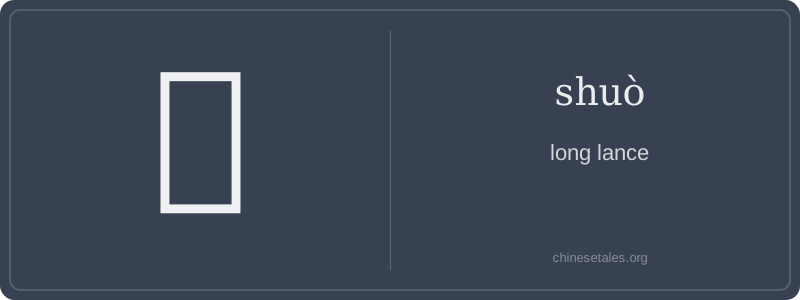
The earliest form of 槊 appears not in oracle bones (too late for this weapon), but in Han dynasty bronze inscriptions and seal script: a clear combination of 木 (mù, 'tree/wood') on the left — representing the wooden shaft — and 朔 (shuò, 'the first day of the lunar month', later borrowed for its sound) on the right. The 朔 component originally depicted a knife (刀) beside a crescent moon (屰 + 月), symbolizing sharpness and cyclical precision — qualities transferred metaphorically to the lance’s lethal timing and edge. Over centuries, 朔 simplified into its modern form, and the whole character stabilized by the Tang, with all 14 strokes locking into place: wood + precision = the perfect war tool.
By the Northern and Southern Dynasties, 槊 had become synonymous with elite cavalry warfare — especially among Xianbei and other steppe-influenced armies who prized long lances for shock combat. It appears repeatedly in the *Book of Wei* and *Zizhi Tongjian*, always associated with high-ranking generals. Poets like Cao Cao and Su Shi later romanticized it as a symbol of heroic resolve and cultivated strength — not brute force, but disciplined power. Visually, the 木 radical grounds it in material reality (wooden shaft), while 朔’s phonetic role anchors pronunciation and subtly reinforces the idea of ‘first strike’, ‘initial thrust’ — echoing its tactical function on the battlefield.
Imagine a Tang dynasty cavalry charge across the Loess Plateau — dust swirling, hooves thundering — and at the center, a general gripping a shuò: not just any spear, but a heavy, shafted lance with a leaf-shaped steel head, designed to pierce armor at full gallop. That’s 槊: a weapon of elite mounted warriors, evoking weight, precision, and aristocratic martial tradition. It’s not a generic ‘spear’ (矛 máo) or ‘halberd’ (戟 jǐ); it’s specifically a long, thrusting lance wielded from horseback — so historically precise that calling a Ming dynasty infantry pike a 槊 would raise eyebrows among classical scholars.
Grammatically, 槊 is almost always a noun, rarely used alone in modern speech but appearing powerfully in literary or historical contexts — often in compound words like 铁槊 (tiě shuò, 'iron lance') or paired with verbs like 执 (zhí, 'to hold') or 挥 (huī, 'to brandish'). You’ll hear it in idioms such as 槊折旗靡 (shuò zhé qí mǐ, 'lances broken, banners fallen'), describing total battlefield collapse. Learners sometimes misread it as shuò (correct) vs. shù (a common error), or confuse it with 硕 (shuò, 'great') — homophone trap! Also, note: it never appears in daily conversation; if you use it in a café, your barista will think you’ve time-traveled.
Culturally, 槊 carries the gravitas of elite martial culture — think Cao Cao’s famous line in the *Records of the Three Kingdoms*: ‘横槊赋诗’ (héng shuò fù shī, 'holding a lance horizontally while composing poetry'), blending warrior prowess with literati elegance. Its rarity today makes it a linguistic artifact — less a word you’ll need for ordering dumplings, more a key to unlocking classical battle scenes, opera, and historical novels.