槢
Character Story & Explanation
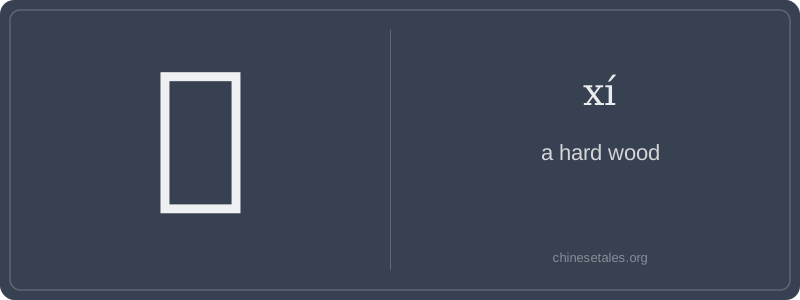
The earliest trace of 槢 appears not in oracle bones — too rare for such a specific timber — but in late Warring States bronze inscriptions and early Han bamboo slips, where it’s written with the wood radical (木) on the left and 习 (xí) on the right. That right side isn’t arbitrary: 习 originally depicted wings flapping (羽 + 日), symbolizing repeated practice — but by the Qin dynasty, its shape had simplified into two 'x'-like strokes. Scribes paired it with 木 to signal 'wood that must be mastered through practice to use well' — bow-makers spent years learning how 槢 bends without breaking.
By the Tang dynasty, 槢 was codified in agricultural manuals like the *Siyi Lun* (Discourse on Four Crafts) as 'the unyielding heartwood of southern elms'. Li Shizhen’s *Bencao Gangmu* (1596) notes its use in medicine — powdered 槢 bark for staunching wounds — linking its physical density to therapeutic 'binding' power. The character’s visual balance — sturdy 木 grounded, active 习 rising — mirrors its cultural role: nature’s resilience made legible, stroke by stroke.
槢 (xí) is a beautifully obscure character — not just 'a hard wood', but specifically the dense, resilient timber of the *Celtis sinensis*, a native Chinese tree prized since antiquity for crafting high-stakes objects: archery bows, ritual chariot parts, and even imperial seal handles. To Chinese speakers, 槢 evokes quiet strength and endurance — it’s not flashy like 红木 (hóngmù, rosewood), but deeply trusted in craftsmanship circles where 'hardness that doesn’t splinter' matters more than gloss. You’ll almost never see it in daily speech or modern writing; it lives in classical texts, forestry reports, and antique restoration workshops.
Grammatically, 槢 functions strictly as a noun — never a verb or adjective — and almost always appears in compound nouns or with measure words like 根 (gēn, for long, rigid things) or 块 (kuài, for cut pieces). It rarely stands alone: saying 'this is 槢' sounds as unnatural as saying 'this is mahogany' without context in English. Learners often mistakenly treat it like a generic word for 'wood' (木 mù) or try to use it adjectivally ('very 槢'), which native speakers would find nonsensical — it’s a proper noun for a specific botanical material, not a descriptive term.
Culturally, 槢 reveals how Chinese lexical precision honors material integrity: one tree, one name, one functional truth. Its near-absence from HSK reflects a deeper truth — Mandarin preserves specialized vocabulary not for frequency, but for fidelity. Mistake it for similar-looking characters (like 袭 or 席), and you risk invoking 'assault' or 'mat' instead of hardwood — a hilarious, if awkward, semantic swerve.