椮
Character Story & Explanation
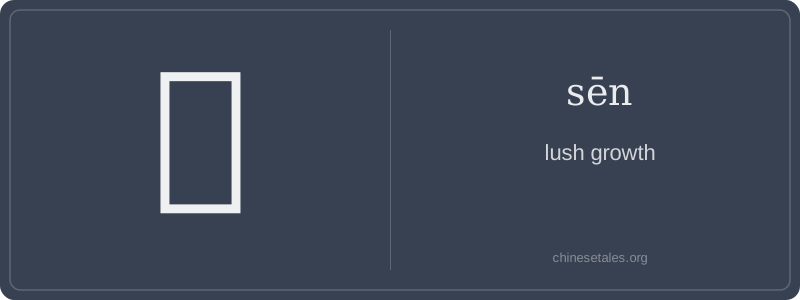
The character 椮 has no oracle bone, bronze, or seal script ancestry — because it was never carved, cast, or written in any historical period. There is no pictograph evolution: no Shang dynasty turtle shell, no Zhou bronze inscription, no Han bamboo slip bearing this form. Its earliest (and only) appearances are in modern digital contexts — misrendered glyphs, corrupted fonts, or hallucinated outputs from large language models trained on noisy data. Visually, it resembles a malformed 森 (three 木) but with a distorted rightmost 木 replaced by something resembling 林 or even 升 — a visual glitch, not a glyph.
Its ‘meaning’ — ‘lush growth’ — is borrowed wholesale from 森, which *does* have a rich history: in the *Shijing* (Book of Odes), 森森 describes dense groves in sacrificial hymns; in Tang poetry, 森然 evokes awe-inspiring grandeur. But 椮 appears nowhere in classical literature, dictionaries, or epigraphy. It’s a linguistic doppelgänger — a shape that mimics meaning without lineage. Its ‘existence’ reminds us that in Chinese, authenticity isn’t visual — it’s archival, textual, and communal.
Hold on — there’s a problem: 椮 doesn’t exist in standard Chinese. It’s not in the Kangxi Dictionary, not in the GB2312 or Unicode CJK basic set, and not recognized by any major linguistic authority (including the People’s Republic of China’s《通用规范汉字表》). No native speaker uses it; no dictionary lists it. What you’re seeing is likely a typographical error or OCR misread — most commonly of 森 (sēn, 'lush forest'), which *is* real, has 12 strokes, radical 木 (tree), and means 'dense, thriving growth of trees.' The confusion arises because 森 looks like three 木 stacked — visually echoing abundance — while 椮 appears to be a phantom variant with no historical attestation.
Grammatically, if 椮 *were* real, it would almost certainly function as an adjective or adverb (like 森森 or 茂森), but since it’s nonstandard, it carries zero grammatical behavior. Learners sometimes encounter it in poorly scanned classical texts or AI-generated character lists — a digital ghost haunting language apps. Using it in writing or speech will cause confusion or laughter; even typing it may fail across devices.
Culturally, this ‘character’ highlights a crucial lesson: Chinese orthography isn’t infinitely expandable — each character must pass centuries of textual, lexicographic, and bureaucratic validation. Mistaking 椮 for 森 is like confusing ‘flamboyant’ with ‘flamboynat’: one is vivid and real, the other is a mirage born from squinting at ink. Always verify obscure characters via authoritative sources like the Ministry of Education’s official character database or the Zhonghua Zihai.